The global investment landscape has shifted meaningfully in recent years, with geopolitics once again taking center stage. Investors, however, don’t have to be subjected to the volatility that geopolitical tensions bring to their portfolios. Rising tensions across multiple regions, ongoing conflicts, and a renewed focus on national security have only strengthened the case for owning the defense and aerospace industries.
The best part is that the industry’s runway is long.
What was once considered a cyclical or politically sensitive industry is increasingly viewed as a long-term structural growth opportunity. Defense and aerospace companies are no longer tied solely to short-term budget cycles or isolated conflicts; instead, they are benefiting from a broad, sustained increase in global spending, technological innovation, and commercial demand. For investors, this offers substantial long-term growth even as short-term conflicts resolve.
Rising Defense Spending: A Powerful Tailwind
Rising conflict and geopolitical tensions worldwide have provided a significant tailwind for the aerospace and defense (A&D) industry. Governments are reassessing their military capabilities in response to evolving threats, driving a meaningful shift in budget priorities, with defense spending rising across both developed and emerging markets.
In the United States, policymakers have continued to emphasize military readiness, modernization, and technological superiority. Recent legislative proposals—including expanded defense funding tied to national security and industrial capacity—underscore a long-term commitment to strengthening defense infrastructure. The numbers are staggering: President Trump’s recently released fiscal 2027 budget proposal includes $1.5 trillion in defense spending, with $1.1 trillion allocated to the Defense Department and an additional $350 billion for munitions.
At the same time, NATO countries are stepping up contributions in a way not seen in decades. Many member nations are now meeting or exceeding the alliance’s 2% of GDP defense-spending target, with some committing to even higher levels. Morningstar now estimates European defense budgets will grow 6.8% annually from 2024 to 2035, representing a structural change after a long period of underinvestment.
This chart from asset manager American Century shows the upswing in global spending since 2000.
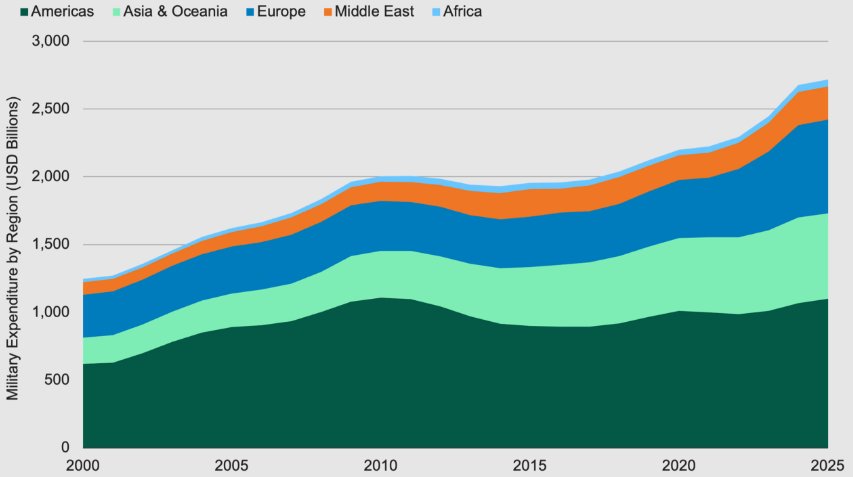
Source: American Century
Several New Growth Engines
For defense contractors and aerospace manufacturers, higher spending translates into long-term contracts, strong order backlogs, and significant revenue potential. Unlike many industries where demand fluctuates widely, defense spending tends to be stable and predictable, particularly during periods of heightened geopolitical risk.
The industry is also experiencing additional revenue drivers that could fuel growth well beyond government spending. It is the nature of that spending—evolving and increasingly technology-driven—that is becoming more central to the A&D industry’s future.
The modern A&D market is increasingly focused on advanced technologies, including cyber capabilities, autonomous systems, artificial intelligence (AI), and space-based assets. This shift is transforming the industry from one centered on traditional hardware to one that integrates software, data, and connectivity. Software-driven systems and services often generate higher margins and recurring revenues than traditional manufacturing, adding a new dimension to the sector’s growth profile.
Then there is the backlog and aftermarket trend to consider. The commercial aerospace industry has effectively created its own feedback loop of profits.
COVID-19 and the subsequent snapback have created an interesting dynamic for commercial aviation. During the pandemic, production of new planes ground to a halt, yet passenger demand has since returned, exceeding pre-pandemic levels in some cases. With airlines focused on expanding capacity, improving efficiency, and replacing older aircraft with more fuel-efficient models, a major backlog has formed. The aerospace industry now carries an estimated backlog of 17,000 orders for new commercial aircraft globally, which analysts say will take a decade to clear—a long-term win for airplane and parts manufacturers. 1
This backlog has also created a notable tailwind for aerospace makers. Older aircraft are staying in service longer, pushing the average age of operational aircraft to 15 years—a record—and forcing airlines to spend more to keep those planes running.
That dynamic has been a boon for Maintenance, Repair, and Overhaul (MRO) demand. Airplane and OEM equipment manufacturers are selling more services and repair parts to keep existing fleets airborne while working to deliver replacements—a rare win-win for the industry.
An Attractive Buy Today
Taken together, these trends create a compelling investment case for A&D. The industry benefits from strong, sustained demand driven by geopolitical realities and long-term structural trends, with defense spending rising globally and commercial aviation recovering and expanding.
Despite these positive fundamentals, valuations in the A&D industry remain relatively reasonable compared to other parts of the market. Since the start of the war in Iran, the Dow Jones U.S. Select Aerospace and Defense Index is down about 9%, allowing the industry to trade at more moderate multiples than high-growth technology stocks. This creates a strong entry point for investors looking to capitalize on future defense spending and the other trends propelling the industry forward.
There are ample ways to do just that. Running our screener at Dividend.com is a great way to find top A&D firms with strong outlooks and dividend potential. For example, Howmet Aerospace Inc (HWM), General Dynamics Corp (GD), L3Harris Technologies Inc (LHX) and Lockheed Martin Corp (LMT) all feature growing dividends and strong profit franchises.
Another option is to go broad. A few A&D industry-focused ETFs offer diversified exposure across the industry, including a mix of defense contractors, aerospace manufacturers, and related suppliers, reducing company-specific risk. While the number of funds is limited, those that do track the industry have long histories and large asset bases, making them a top choice for investors seeking broad exposure.
Aerospace and Defense ETFs
These funds were selected based on YTD total return, which ranges from 28% to 110%. They carry expenses between 0.35% and 0.97%, assets under management between $125M and $8.3B, and yields between 0% and 0.7%.
| Ticker | Name | AUM | YTD Total Ret (%) | Yield | Exp Ratio | Security Type | Actively Managed? |
|---|---|---|---|---|---|---|---|
| DFEN | Direxion Daily Aerospace and Defense Bull 3X Shares | $125.5M | 110.5% | 0.4% | 0.97% | ETF | No |
| EUAD | Select STOXX Europe Aerospace and Defense ETF | $1.1B | 74.1% | 0.1% | 0.5% | ETF | No |
| SHLD | Global X Defense Tech ETF | $2.9B | 67.6% | 0.41% | 0.5% | ETF | No |
| ARKX | ARK Space Exploration and Innovation ETF | $341M | 38.6% | 0% | 0.78% | ETF | Yes |
| ITA | iShares U.S. Aerospace and Defense ETF | $8.3B | 35.8% | 0.4% | 0.38% | ETF | No |
| XAR | SPDR S&P Aerospace and Defense ETF | $3.6B | 32.3% | 0.2% | 0.35% | ETF | No |
| PPA | Invesco Aerospace and Defense ETF | $5.72B | 29.1% | 0.7% | 0.57% | ETF | No |
| MISL | First Trust Indxx Aerospace and Defense ETF | $160M | 28.3% | 0.3% | 0.6% | ETF | Yes |
The global A&D industry is undergoing a transformation driven by rising geopolitical tensions, increased government spending, and rapid technological innovation. What was once a traditional, cyclical industry is evolving into a dynamic, multifaceted growth story.
For investors, the opportunity lies in the combination of stable demand, expanding capabilities, and attractive valuations. As governments prioritize security and resilience and the aerospace industry embraces digital transformation, the industry is well-positioned for long-term growth.
Bottom Line
The global defense and aerospace industry offers a compelling long-term investment opportunity, driven by sustained increases in global defense spending, a rebound in commercial aviation, and rapid technological advancements, such as AI and predictive maintenance.
1 American Century (April 2026). Rising Demand in the Global Aerospace and Defense Industry