For much of the past decade, value investing felt like a losing trade as growth stocks dominated market leadership, fueled by falling interest rates, abundant liquidity, and investor preference for long-duration earnings streams.
However, market cycles do not last forever.
As investors enter an environment of higher uncertainty, elevated equity valuations, and increased volatility, the case for value stocks becomes stronger. Value investing offers more than nostalgic style preference; it provides a practical approach to buying stocks at prices that allow room for error. In today’s market, that margin of safety matters more than it has in years.
High Valuations and Rising Risk
Today’s equity market reflects a contradiction: optimism persists, yet risks have multiplied quietly. Gains in tech stocks like the Magnificent Seven have pushed broad equity indexes to elevated valuations.
That does not mean a crash looms, but future returns will likely prove constrained. Investors paying high prices for earnings effectively borrow returns from the future. Strong performance may continue briefly, but the market grows less forgiving. Disappointment—slower growth, margin pressure, higher funding costs, or policy shocks—triggers sharper drawdowns at stretched valuations.
At the same time, volatility has become a more persistent feature of the investing landscape. Markets now react sharply to changes in interest-rate expectations, inflation data, and geopolitical headlines. Even with a stable economy, uncertain policy paths and growth paces create frequent repricing events. This matters because high-valuation markets prove more vulnerable to sudden narrative shifts. When priced for perfection, even “good” news fails to lift stocks, while negative surprises trigger outsized declines.
Additionally, concentration risk adds fragility. Mega-cap names dominate indices, amplifying downside risk during leadership rotations. A market reliant on a few stocks for performance remains healthy but faces greater exposure to style reversals.
These conditions—elevated valuations, greater volatility, and concentration—heighten investors’ risk awareness. In this environment, value investing shifts gear from fearing “missing out” to protecting capital while capturing equity upside.
Value Could Be the Answer
Investors may find an answer to today’s market in value stocks.
Value stocks are companies trading at low prices relative to their fundamentals, such as earnings, cash flow, book value, dividends, or other measures of intrinsic worth. Unlike growth stocks, which trade on expectations of future earnings expansion, value stocks reflect more modest assumptions. In many cases, the market already discounts slower growth, near-term uncertainty, or cyclical pressures.
That discounting makes value attractive. Value investing rests on the idea that markets overreact by punishing solid businesses harshly or pricing them as if current challenges are permanent. When expectations are low, a company needs only to be “less bad” than assumed or stable enough to prove pessimism wrong to generate strong returns.
Value suits today’s market environment especially well. High valuations bring the biggest risk of disappointment. Growth stocks demand continued flawless execution to justify their prices, while value stocks require far less perfection and offer a built-in cushion through lower valuation multiples that reduce downside from market repricing.
Value Is a Value
The central value investing concept is margin of safety: buying assets at prices that protect against errors. Currently, value offers a huge margin of safety.
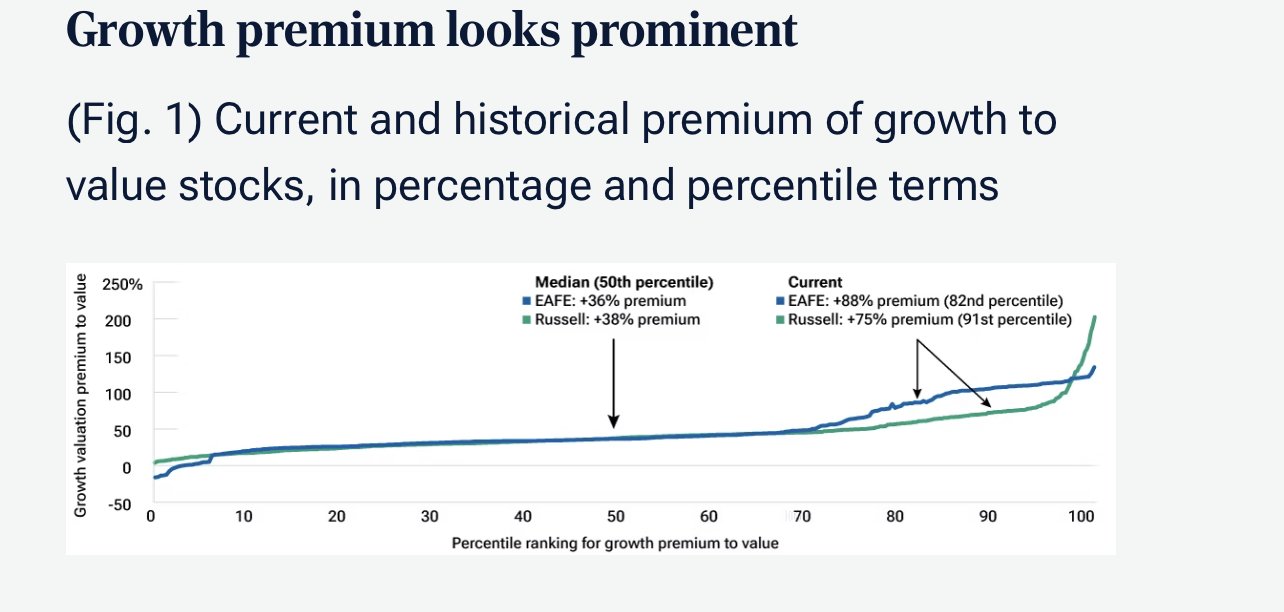
Trailing 12-month P/E ratios show value stocks—via the Russell 1000 Value Index—trading at a 30% discount to the S&P 500 Index. They trade at a 50% discount to growth stocks in the Russell 1000 Growth Index. 1
This chart from asset manager T. Rowe Price highlights how large the discount has become, one of the biggest points in market history.
Source: T. Rowe Price
This wide margin of safety cushions much of the market’s volatility. Investors can now buy durable, quality companies essentially for pennies.
At the same time, this huge discount enables a reversion to the mean, as value has long outperformed growth and could soon return to that status.
How to Use Value Stocks in a Portfolio
Given its huge discount and the overall higher-risk market environment, investors may want to add a value style of investing to their portfolios. Investors can implement value exposure in several ways based on objectives and preferences.
Our Dividend.com screener uncovers many choices.
One approach uses broad value ETFs for diversified exposure to value stocks across sectors and market caps, reducing stock-specific risk. Investors seeking a stronger tilt can choose strategies focused on deeply discounted names or factors like profitability and cash flow. Active management and ETFs also excel in value investing by adding alpha.
Active Value ETFs
These ETFs offer exposure to value strategies through active management. Sorted by YTD total return from 2.5% to 9.6%, they have assets under management between $287M and $26B, expenses of 0.15% to 0.44%, and current yields between 1.3% and 2.3%.
| Ticker | Name | AUM | YTD Total Ret (%) | Yield (%) | Exp Ratio | Security Type | Actively Managed? |
|---|---|---|---|---|---|---|---|
| AVUV | Avantis U.S. Small-Cap Value ETF | $20B | 9.6% | 1.3% | 0.25% | ETF | Yes |
| AVLV | Avantis U.S. Large-Cap Value ETF | $9.1B | 8.6% | 1.4% | 0.15% | ETF | Yes |
| DFAT | Dimensional U.S. Targeted Value ETF | $12B | 8.4% | 1.5% | 0.28% | ETF | Yes |
| DFUV | Dimensional U.S. Marketwide Value ETF | $12.6B | 6.5% | 1.3% | 0.21% | ETF | Yes |
| DFLV | Dimensional U.S. Large Cap Value ETF | $4.64B | 6.4% | 1.5% | 0.22% | ETF | Yes |
| JAVA | JPMorgan Active Value ETF | $5.21B | 5.7% | 1.6% | 0.44% | ETF | Yes |
| FLV | American Century Focused Large Cap Value ETF | $287M | 5.2% | 2.3% | 0.42% | ETF | Yes |
| CGDV | Capital Group Dividend Value ETF | $26B | 2.5% | 1.7% | 0.33% | ETF | Yes |
Markets rarely reward complacency, and today’s high valuations, rising uncertainty, and concentration risk call for thoughtful risk-taking. Value stocks provide a compelling alternative with lower expectations, higher margins of safety, and returns that benefit when markets become less forgiving.
Bottom Line
Whether through ETFs, blended allocations, or selective stock picking, value investing lets investors capture equity upside while enhancing portfolio resilience. In an investment environment that favors perfection, buying value provides a simple way to restore balance.
1 Invesco (December 2025). Time to consider value?