For decades, the role of bonds in a portfolio was remarkably straightforward. Investors bought fixed-income to preserve capital, generate predictable income, and offset the volatility of stocks. Equities drove growth, while bonds provided stability. It was one of investing’s most enduring relationships and the foundation of countless balanced portfolios. That framework worked well for generations.
However, the bond market has changed dramatically over the past several years. The fixed-income marketplace has expanded significantly, and investors now have access to hundreds of ETF strategies spanning nearly every segment of the bond universe—from Treasury Inflation-Protected Securities and preferred securities to securitized credit and emerging market debt. With these new options, many investors have also discovered that traditional core bond indexes were not as diversified—or as defensive—as once believed, and bonds have taken on a different role in a portfolio.
Today, bond investing has evolved beyond its traditional role as a source of income and diversification into a tool for achieving specific investment outcomes.
Bonds Are No Longer Just the Defensive Side of a Portfolio
Historically, most investors viewed fixed income through a narrow lens: generate interest income, protect portfolio principal, and reduce volatility during equity market declines. That approach centered on broad market indexes, such as the Bloomberg U.S. Aggregate Bond Index (Agg) or a handful of familiar asset classes, such as U.S. Treasuries, investment-grade corporate bonds, and municipal securities. Individual bond market sectors received relatively little attention outside of institutional investors.
For many years, this approach was sufficient, and fixed-income took a backseat to equity growth.
However, the events of the past several years have challenged many of those assumptions. Inflation returned with a force few investors anticipated, interest rates rose at the fastest pace in decades, and bond market volatility reached levels that surprised even seasoned participants. Many investors who had viewed fixed-income primarily as a defensive allocation realized that broad bond indexes carried meaningful interest-rate risk and were not always as diversified as they appeared.
At the same time, these risks have created opportunities. Higher yields allowed bonds to provide more income and compete with equity returns in many respects, while volatility offered the chance to add capital gains. Investors also began looking beyond the standard asset classes within the bond world.
This shift has changed how investors view bonds as an asset class. Rather than simply serving as a source of income or downside protection, bonds are increasingly used as strategic building blocks designed to achieve specific investment objectives.
The Main Drivers
The key to making all this work comes down to a few main drivers, the most straightforward of which is access. Investors of all sizes now have greater access to esoteric bond asset classes.
The ETF boom has leveled the playing field for all investors. Historically, accessing specialized bond sectors often required purchasing individual securities or investing through specialized managers, which put asset classes like collateralized loan obligations (CLOs) and emerging market bonds out of reach for many. Today, ETFs provide efficient access to virtually every corner of the global fixed-income market.
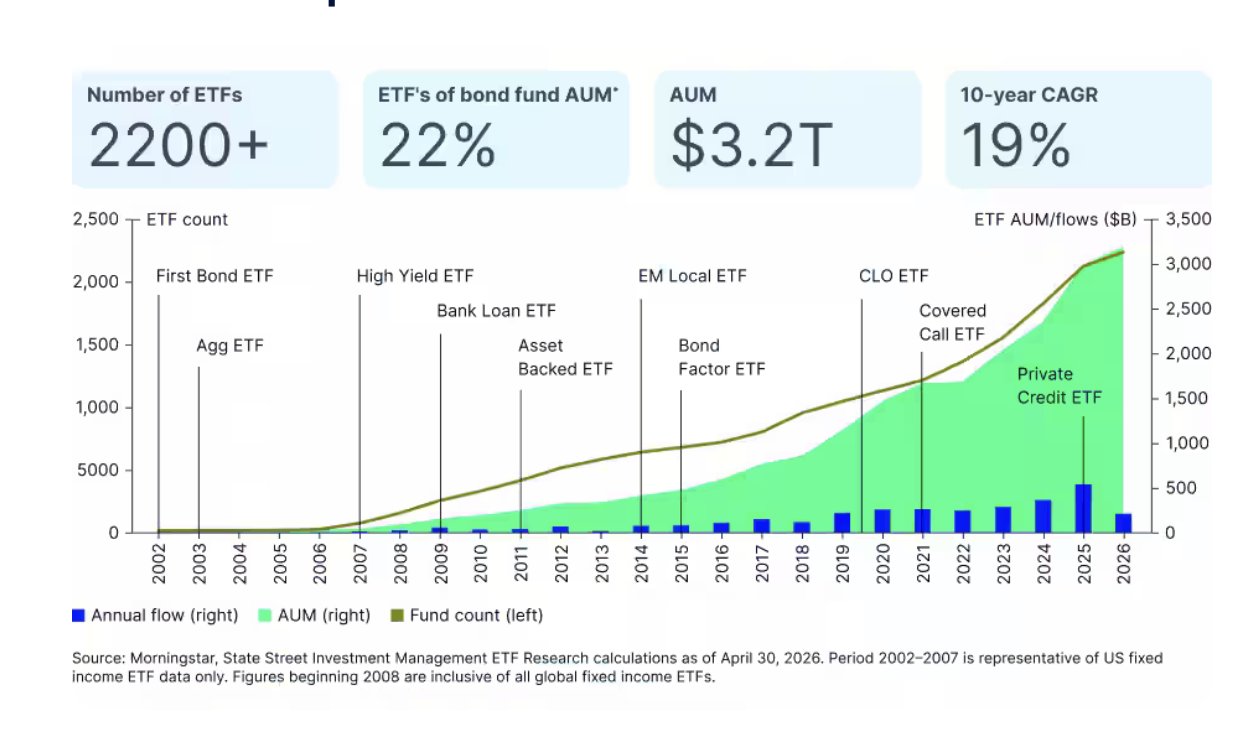
This chart from State Street shows how many bond ETFs are now available and when the first milestones for many specialized fixed-income asset classes were launched.
Source: State Street
According to State Street, ETFs are fundamentally changing how investors think about fixed income. Bonds of all types can increasingly be used as strategic building blocks designed to achieve specific investment objectives.
Not only do investors have access to more bond types, but the efficiency with which fund managers operate has also expanded. The fixed-income market is no longer ruled by phone calls, handshakes, and limited liquidity. Technology has continued to level the playing field through trading platforms like Tradeweb and MarketAxess, while systematic strategies, algorithms, and automated execution tools have helped expand access and deliver better results for active ETFs and managers.
Because of this access, the bond market now offers an enormous range of securities with very different risk and return characteristics. A portfolio built around a specific objective may look very different from one designed to replicate a benchmark, allowing investors to tailor their bond exposure to individual financial goals rather than relying on a one-size-fits-all allocation.
Make Outcome Investing Accessible
Instead of asking, “How much should I allocate to bonds?” investors are increasingly asking, “What do I want my bond allocation to accomplish?” This shift has been made possible by access to more bond types and a changing market environment, and it should ultimately lead to better portfolio outcomes.
With that in mind, investors may want to ask that same question and allocate accordingly. As shown, the number of ETFs providing access to bond subsectors has grown exponentially.
Active Core-Plus Bond ETFs
These ETFs were selected for their low-cost exposure to active bond management within the unconstrained, dynamic, and core-plus sectors. Sorted by YTD total return, they range from 0.3% to 2.8%, with expense ratios from 0.10% to 0.71%, assets from $51M to $22B, and current yields between 4.2% and 6.8%.
| Ticker | Name | AUM | YTD Total Ret (%) | Yield (%) | Exp Ratio | Security Type | Actively Managed? |
|---|---|---|---|---|---|---|---|
| JCPB | JPMorgan Core Plus Bond ETF | $5.78B | 2.8% | 5.3% | 0.40% | ETF | Yes |
| BOND | PIMCO Active Bond ETF | $5.5B | 2.5% | 5.3% | 0.71% | ETF | Yes |
| VPLS | Vanguard Core Plus Bond ETF | $138M | 2.5% | 4.8% | 0.2% | ETF | Yes |
| TOTL | SPDR DoubleLine Total Return Tactical ETF | $3.5B | 2.3% | 5.1% | 0.55% | ETF | Yes |
| AVIG | Avantis Core Fixed-Income ETF | $1B | 2.2% | 5% | 0.15% | ETF | Yes |
| BINC | BlackRock Flexible Income ETF | $8.14B | 2.1% | 5.5% | 0.52% | ETF | Yes |
| FIXD | First Trust TCW Opportunistic Fixed-Income ETF | $4.32B | 2.1% | 4.3% | 0.65% | ETF | Yes |
| DBND | DoubleLine Opportunistic Bond ETF | $413M | 2% | 4.8% | 0.45% | ETF | Yes |
| DFCF | Dimensional Core Fixed-Income ETF | $243M | 2% | 4.6% | 0.19% | ETF | Yes |
| CGCP | Capital Group Core Plus Income ETF | $4.5B | 1.8% | 4.8% | 0.34% | ETF | Yes |
| OBND | SPDR Loomis Sayles Opportunistic Bond ETF | $51M | 1.4% | 6.8% | 0.55% | ETF | Yes |
| FBND | Fidelity Total Bond ETF | $22B | 0.3% | 4.9% | 0.36% | ETF | Yes |
| VCRB | Vanguard Core Bond ETF | $3B | 0.3% | 4.20% | 0.10% | ETF | Yes |
Fixed income is undergoing one of the most significant transformations in its history. Bonds are no longer viewed simply as the conservative portion of a portfolio tasked with generating income and offsetting stock market volatility. Instead, they are becoming strategic tools that allow investors to pursue specific outcomes—whether inflation protection, enhanced yield, downside risk management, tax efficiency, diversification, or total return.
This evolution has been driven by several powerful forces: higher interest rates have restored meaningful income to the bond market, ETF innovation has expanded access to specialized fixed-income sectors, active management has grown more valuable as bond markets become more complex, and investors themselves have become more intentional about portfolio construction.
Rather than asking how much to allocate to bonds, today’s investors are increasingly asking what they want their bond portfolios to accomplish—a powerful trend that should yield positive results.
Bottom Line
With an expanding toolkit of specialized ETFs and active strategies now available, investors have more flexibility than ever to build bond portfolios designed not simply to own fixed-income, but to achieve specific financial outcomes.