Don’t look now, but higher interest rates are back on the menu. Persistent inflation and a resilient economy give the Federal Reserve reason to keep tightening. These days, the chances of tightening are near 100%. That is bringing fresh questions about what comes next for stocks and bonds to the forefront of many investors’ minds.
The question investors should be considering, however, isn’t whether the Fed will tighten, but the speed of those increases.
The pace of hikes has a substantial influence on portfolio returns. History suggests that gradual hiking cycles give businesses and markets more time to adjust, allowing earnings growth and bond income to help absorb higher borrowing costs. Understanding that relationship can help investors look beyond the next Fed meeting and position their portfolios for the path that follows.
The Fed Tightens Its Grip
The Federal Reserve is raising interest rates again, putting monetary policy back at the center of portfolio decisions. With economic activity expanding and several factors in the commodity space persisting, inflation has jumped once again, forcing the central bank to act.
In September, policymakers increased the federal funds target range by a quarter percentage point to 3.75%–4.00%. They held rates steady in October, though two officials preferred another increase, and markets have since priced in an overwhelming likelihood of a December hike.
FedWatch tools and futures-based trackers showed probabilities ranging from approximately 95% to 100%, depending on the calculation and timestamp, while Reuters reported odds of 99%. A hike is therefore almost fully anticipated, although market pricing can change before the decision.
Looking ahead, more hikes could be on the docket as inflation remains stubborn and the economy stays strong.
The Speed of Tightening Matters
So are investors at a loss? Is it game over because the Fed is guaranteed to hike more over the next few meetings? Not so fast. For portfolios, the greater determinant may be just how quickly officials raise rates—the pace is what matters.
The proof is in the data.
Interest rates influence the economy through borrowing costs and financial conditions. Higher rates make mortgages, business loans, and other financing more expensive, discouraging spending and investment, but those effects develop with a lag—meaning consumers and businesses can absorb slow rate hikes more easily.
According to Charles Schwab, looking at the 18 tightening episodes since World War II, fast cycles produce poor results while slow cycles produce positive returns. The firm defines fast cycles as those in which the Fed raised rates at nearly every meeting, and slow cycles as those in which officials skipped at least one meeting between increases on average. Slow cycles generally produced stronger equity performance in the year after the initial hike, with the average maximum S&P 500 drawdown within that year running approximately 12%, compared with 16% during fast cycles. 1
This chart from Schwab using Ned Davis data highlights the relationship.
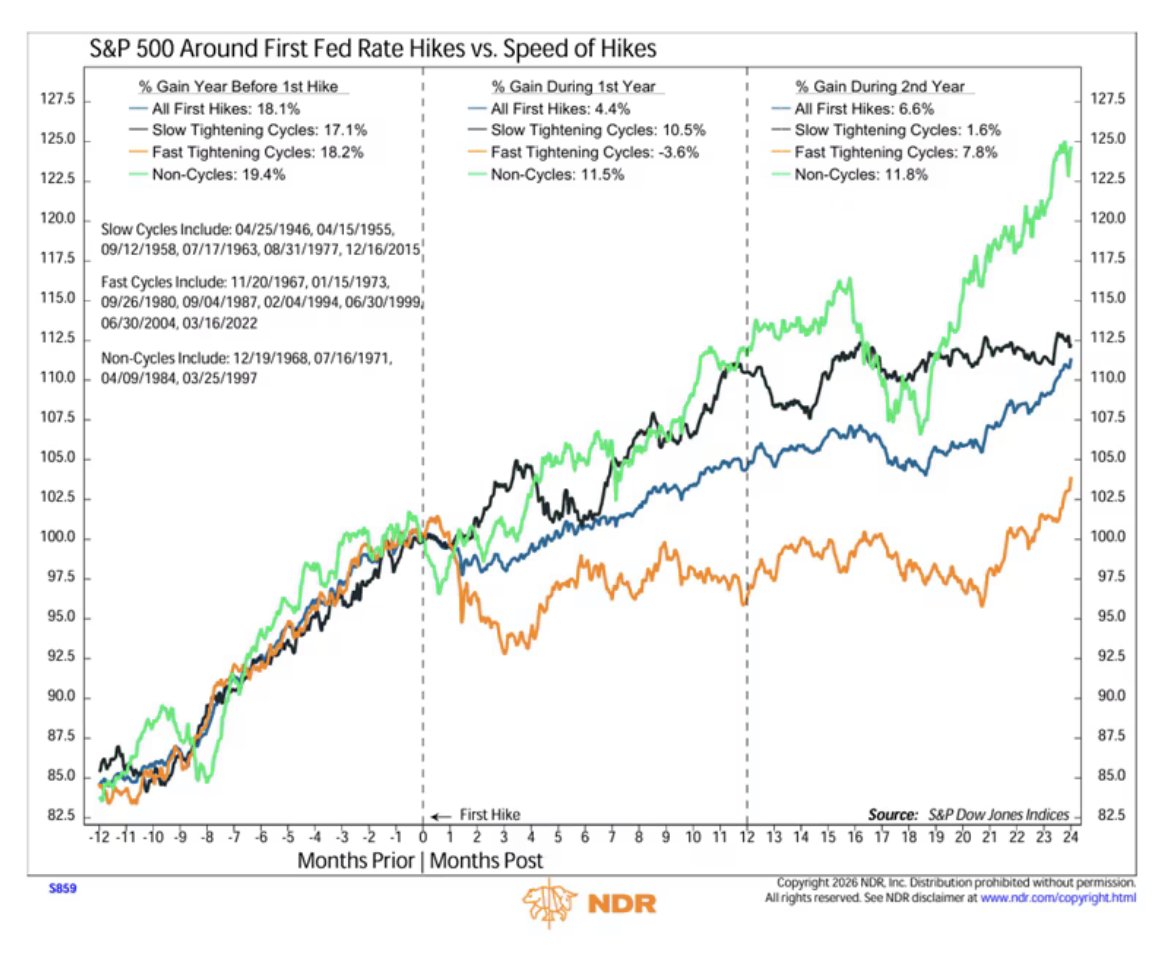
Source: Charles Schwab
Franklin Templeton’s analysis of six previous tightening episodes since 1994 reaches a similar conclusion.
Bonds also have an interesting relationship with the pace of hikes.
Franklin Templeton found that core bonds produced a median 12-month return of 3.6% following initial hikes in its historical sample, with losses occurring only after the aggressive starts in 1994 and 2022. The analysis also found that longer-term Treasury yields responded inconsistently to Fed increases: short-term yields are more closely tied to the policy rate, while longer yields reflect expectations about inflation, growth, and future policy. A Fed hike therefore need not produce an equivalent increase across the entire bond market.
The data shows that pacing, rather than whether the Fed hikes at all, is what matters most to investors.
Putting the Pace of Tightening Into Practice
With this information, investors can develop a plan. So far, the Fed appears to be taking a wait-and-see approach, letting hikes work through the data before raising rates again. That is beneficial for portfolios and represents a slow pace of tightening. Recent drops in crude oil prices are also helping keep inflation more in check, rather than allowing it to follow a runaway path.
This is a positive development for portfolios and investors. If it continues, both bonds and stocks should perform well. Investors shouldn’t fight the Fed — embracing the path and its pacing is key.
Asset Allocation ETFs
These ETFs are selected for their ability to access asset allocation models within one ticker. Sorted by YTD total return, they range from 4.2% to 14.8%, with expense ratios between 0.19% and 0.35%, AUM between $240M and $2.03B, and current yields between 1.1% and 4.9%.
| Ticker | Name | AUM | YTD Total Ret (%) | Yield (%) | Exp Ratio | Security Type | Actively Managed? |
|---|---|---|---|---|---|---|---|
| NTSX | WisdomTree U.S. Efficient Core Fund | $990M | 14.8% | 1.1% | 0.20% | ETF | Yes |
| AOA | iShares Core Aggressive Allocation ETF | $1.88B | 10.4% | 2.9% | 0.19% | ETF | No |
| CGBL | Capital Group Core Balanced ETF | $250M | 11.3% | 1.9% | 0.33% | ETF | Yes |
| AOR | iShares Core Growth Allocation ETF | $2.03B | 7.8% | 3% | 0.20% | ETF | No |
| GAL | SPDR SSGA Global Allocation ETF | $240M | 7.2% | 4.4% | 0.35% | ETF | No |
| AOM | iShares Core Moderate Allocation ETF | $1.37B | 5.4% | 3.1% | 0.20% | ETF | No |
| AOK | iShares Core Conservative Allocation ETF | $604M | 4.2% | 4.9% | 0.21% | ETF | No |
A gradual pace of Fed rate hikes could leave room for both stocks and bonds to deliver positive returns, particularly if inflation cools while the economy continues to expand. For investors, this supports maintaining diversified equity exposure, emphasizing businesses with durable cash flow, and managing bond duration to balance income with interest-rate risk.
Faster tightening would create a tougher environment, making liquidity and credit quality more valuable.
Portfolios built to withstand either path give investors the flexibility to rebalance as changing expectations create opportunities.
Bottom Line
The pace of Federal Reserve rate hikes could play a major role in shaping stock and bond returns. Historically, gradual tightening has given corporate earnings and bond income more time to absorb higher borrowing costs, while aggressive cycles have produced deeper losses.
1 Charles Schwab (September 2026). Take a Hike: Rate Hikes and Market Impacts