For decades, investors relied on a familiar fixed-income playbook. U.S. Treasury bonds provided safety, investment-grade corporate bonds delivered incremental income, and higher-yielding credit sectors offered additional return potential for those willing to assume more risk. The formula was straightforward and generally effective. Today’s bond market looks much different—with significant volatility, tightened spreads, and monetary policy uncertainty to consider. In many cases, investors find themselves facing an uncomfortable trade-off between stability and income.
Preferred stocks could be the answer to that trade-off.
Often overlooked by both stock and bond investors, preferred stocks frequently offer income levels that exceed those of traditional fixed-income sectors while providing characteristics that can complement both equity and bond allocations. Today’s market environment could be especially favorable for the asset class.
Overlooked and Unique
The vast bulk of investors simply ignore preferred stocks, and it’s easy to see why. Preferred securities are hybrid investments combining characteristics of both debt and equity, issued primarily by banks, insurance companies, utilities, and other financial institutions seeking to raise capital.
Preferred shareholders occupy a position in the capital structure between bondholders and common stockholders. In the event of bankruptcy, preferred investors generally rank ahead of common shareholders but behind bondholders.
Despite their name, preferred stocks often behave more like bonds than common stocks. Most preferred shares pay fixed or floating dividends that are typically higher than those offered by common stocks, and unlike common dividends—which can fluctuate significantly based on company performance—preferred dividends are generally predetermined. Those dividends must also be paid before any common dividends, and if suspended, most preferred stocks require all missed payments to be made whole before the company can resume paying common shareholders.
These factors create a more predictable income profile and help explain why preferred stocks function more like bonds in a portfolio.
High Yields, Lower Taxes, and Less Volatility
This uniqueness also helps explain why preferred stocks remain an attractive option for income seekers.
For starters, yield remains a top draw for the asset class.
One of the biggest challenges facing fixed-income investors today is that many traditional sectors no longer offer compelling compensation relative to their risks. Treasury yields remain attractive compared with recent history, but prices can be highly sensitive to interest rate changes. Investment-grade corporate bonds offer incremental income, but spreads have compressed considerably as investors searched for yield.
Preferred securities currently offer yields that compare favorably to many traditional fixed-income sectors.
According to Charles Schwab, preferred securities continue to provide some of the highest yields available within the public investment-grade universe. The Bloomberg U.S. Corporate Bond Index averages around 5.1%, while the ICE BofA Core Plus Fixed Rate Preferred Securities Index currently pays 6.6%—giving investors 1.5 extra percentage points in yield for similarly rated assets. Notably, preferred stocks are yielding nearly as much as junk bonds, with the Bloomberg U.S. Corporate High-Yield Bond Index offering 7.0%. 1
Those yields may be more advantageous than investors realize, since many preferred stocks pay qualified dividends subject to lower tax rates than traditional interest income—as low as 0% for some investors. For someone in the highest tax bracket (37%), preferred stock still pays 5% after tax, versus 3.8% for junk bonds and 2.8% for investment-grade corporates.
Preferred stocks may also give investors a much-needed reduction in portfolio volatility. Their bond-like nature and placement above common equity both contribute to this front.
While preferreds can experience price fluctuations, their return characteristics often differ significantly from common stocks and high-yield bonds. Their elevated yields can help cushion price volatility while providing ongoing income. A chart from State Street examining median rolling 36-month standard deviation of returns over the past 15 years highlights the lower volatility of preferred stocks. When measuring yield per unit of trailing 36-month volatility, State Street found preferred stocks very attractive relative to U.S. Treasuries.
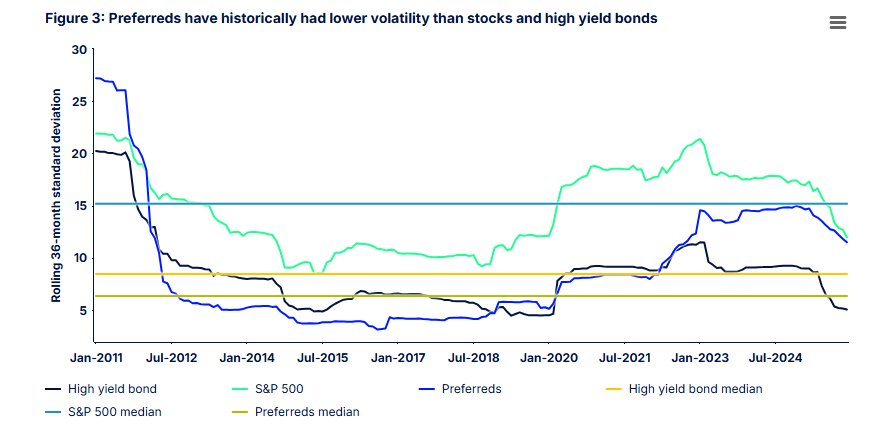
Source: State Street
The Current Environment May Be Especially Favorable
Preferred stock’s uniqueness makes it an attractive asset class, and today’s backdrop appears particularly supportive for these securities.
Interest rates remain elevated compared with the previous decade, allowing newly issued preferred shares to offer attractive income streams. At the same time, concerns about economic growth and credit spreads have kept some investors cautious toward traditional corporate bonds.
Preferred securities occupy an interesting position, offering income levels that often exceed investment-grade corporate bonds while benefiting from improving financial sector fundamentals and potential tax advantages. In a market where investors increasingly worry about being undercompensated for risk, preferreds may offer a more attractive balance between income and risk exposure.
With that in mind, adding a dose of preferred stock makes considerable sense.
Historically, building a diversified preferred securities portfolio was not always easy.
The market can be complex, with thousands of individual issues featuring varying structures, call provisions, floating-rate features, and credit characteristics. Fortunately, ETFs have made the asset class far more accessible.
Today, investors can gain broad preferred securities exposure through diversified preferred stock ETFs, which provide access to dozens or even hundreds of individual preferred issues while simplifying portfolio construction. Active management can also enhance yields and reduce risk and volatility.
Preferred Stock ETFs
These funds are selected based on their ability to tap into preferred stock and their assets under management, sorted by one-year total return, which ranges from 5.2% to 9.7%. Expense ratios range from 0.2% to 0.85%, AUM falls between $0.5B and $13B, and yields range from 4.3% to 7.4%.
| Ticker | Name | AUM | YTD Total Ret (%) | Yield (%) | Exp Ratio | Security Type | Actively Managed? |
|---|---|---|---|---|---|---|---|
| PFXF | VanEck Preferred Securities ex Financials ETF | $1.2B | 9.7% | 7.3% | 0.41% | ETF | No |
| PFF | iShares Preferred and Income Securities ETF | $12.7B | 9% | 7.38% | 0.46% | ETF | No |
| PGX | Invesco Preferred ETF | $4.4B | 6.8% | 7.2% | 0.50% | ETF | No |
| PREF | Principal Spectrum Preferred Securities Active ETF | $587M | 5.9% | 4.31% | 0.55% | ETF | Yes |
| PFFD | Global X U.S. Preferred ETF | $2.2B | 5.3% | 6.48% | 0.23% | ETF | No |
| FPE | First Trust Preferred Securities and Income ETF | $5.1B | 5.2% | 6.09% | 0.85% | ETF | Yes |
| CSPF | Cohen and Steers Preferred and Income Opportunities Active ETF | $176.63M | 2.86% | 5.16% | 0.59% | ETF | Yes |
| JHPI | John Hancock Preferred Income ETF | $178.26M | 2.07% | 5.79% | 0.54% | ETF | Yes |
| PGF | Invesco Financial Preferred ETF | $719.24M | -0.02% | 6.33% | 0.55% | ETF | No |
| PSK | State Street SPDR ICE Preferred Securities ETF | $724.76M | -0.09% | 7.03% | 0.45% | ETF | No |
Preferred securities have long occupied a somewhat overlooked corner of the investment universe, sitting between traditional bonds and common stocks without fitting neatly into either category.
That may be precisely what makes them attractive today.
As Treasury volatility remains elevated and corporate bond spreads offer less compensation for risk, preferred securities provide an alternative income source combining attractive yields, relatively stable cash flows, potential tax advantages, and diversification benefits.
Bottom Line
Preferred securities occupy a unique space between stocks and bonds, offering investors an attractive combination of high income, potential tax advantages, and diversification benefits at a time when many traditional fixed-income sectors appear less compelling.
1 Charles Schwab (May 2026). Preferreds Might Offer Value Amid Volatility