The global economic environment today is anything but synchronized. Over the past several years, economies have diverged in meaningful ways, driven by differences in inflation trends, central bank policies, fiscal responses, and geopolitical developments. While the United States remains a dominant force in global markets, it is no longer the sole driver of returns across asset classes—particularly in fixed-income.
In a world where central banks are moving at different speeds, yield curves are evolving independently, and credit conditions vary widely by region, opportunities are no longer concentrated in a single market.
For bond investors, this creates a compelling case for looking beyond domestic markets. A global fixed-income allocation is no longer just a diversification tool—it is increasingly a source of return, resilience, and flexibility in an environment defined by divergence.
The Limits of Home Bias
Many fixed-income investors maintain a strong home bias, and it is easy to see why. The familiarity, currency considerations, and depth of U.S. bond markets make them an obvious choice. Treasuries are as good as gold, and the U.S. bond market—at around $56 trillion, the largest in the world—makes it tempting to focus exclusively on domestic fixed-income.
However, this thinking can lead to missed opportunities, and historical data reinforces that point clearly.
According to data from asset manager Insight Investment, the U.S. bond market has rarely been the top performer within the global fixed-income universe over the past two decades. In fact, it has failed to rank among the top-performing regions more than half the time. 1
Moreover, the Bloomberg U.S. Aggregate Bond Index (Agg) has underperformed the Global Agg on risk-adjusted, forex-hedged returns over that same period. This chart from Insight highlights the Agg’s underperformance both over the long term and since the pandemic.
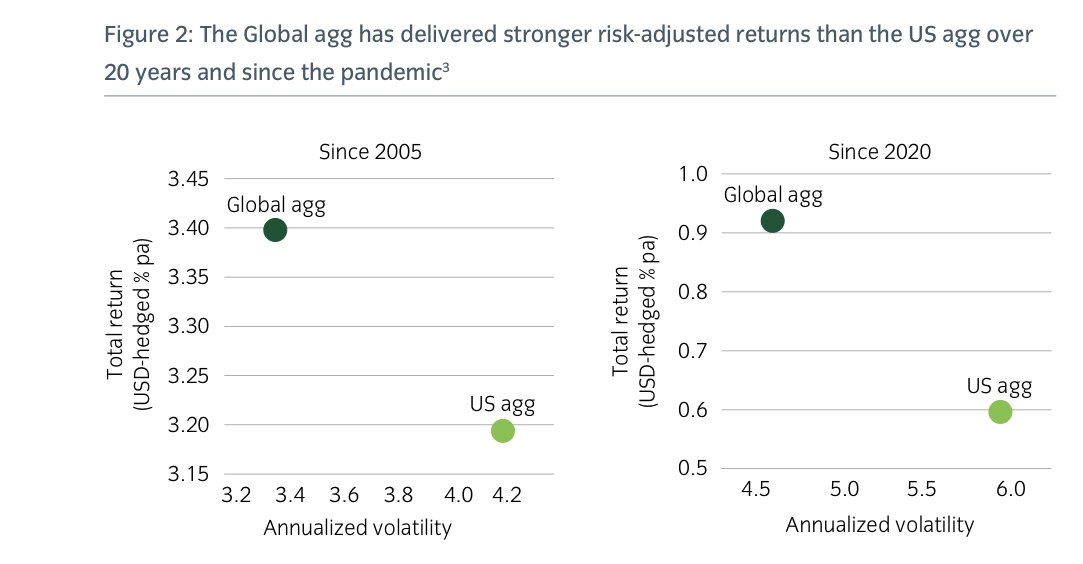
Source: Inisght Investment
A Fragmented Global Economy Creates Opportunity
All of this underscores a critical insight: leadership in bond markets rotates.
Different regions outperform at different times depending on local economic conditions, interest rate cycles, and policy decisions. When one country is tightening monetary policy, another may be easing; when one economy is slowing, another may be accelerating. These differences create opportunities for investors able to allocate capital across regions.
Global bond indices have historically reflected this advantage, as shown in Insight’s return data.
Today’s bond market is increasingly fragmented, with inflation, growth, and central bank policy diverging meaningfully across countries rather than moving in lockstep. In the United States, inflation has moderated but remains somewhat sticky, keeping the Federal Reserve in a cautious holding pattern with rates still elevated. The eurozone has seen faster disinflation, prompting the European Central Bank to begin easing, while the Bank of England faces a more mixed backdrop with persistent services inflation keeping policy relatively tight. Meanwhile, Japan is moving in the opposite direction, gradually exiting years of ultra-loose monetary policy as inflation finally takes hold—a historic shift for global rates.
This doesn’t even account for differences in economic growth or projections.
By expanding their opportunity set, investors can take advantage of regional differences in policy, economic activity, and inflation rates—and that will support returns.
The Power of Going Global
Beyond returns, a global allocation can produce other meaningful benefits for a portfolio.
According to Insight, global fixed-income has historically demonstrated lower volatility and better risk-adjusted outcomes than domestic-only portfolios, particularly when currency risk is managed effectively.
In periods of market stress, this diversification becomes even more valuable. Global credit allocations have tended to experience less severe spread widening than more concentrated regional exposures, reinforcing their role as a stabilizing force. Going global can reduce portfolio swings and allow bonds to serve as a genuine ballast.
Ultimately, global bonds allow investors to build portfolios that are not only more diversified but also more resilient across a range of economic scenarios.
The good news is that adding global exposure to a bond portfolio is straightforward today. Investors looking to incorporate global fixed-income have several practical approaches available.
One of the simplest and most efficient methods is through exchange-traded funds (ETFs) that track global bond indices or actively manage global fixed-income portfolios. These vehicles provide instant diversification across regions, sectors, and issuers, while offering the liquidity and transparency of the ETF structure.
International Bond ETFs
These ETFs are selected for their ability to access various international and global bond sectors at low cost, sorted by one-year total return ranging from -2.2% to 9.5%. Expense ratios range from 0.05% to 0.85%, AUM falls between $50M and $86B, and current yields range from 2.1% to 5.31%.
| Ticker | Name | AUM | 1-year Total Ret (%) | Yield (%) | Exp Ratio | Security Type | Actively Managed? |
|---|---|---|---|---|---|---|---|
| FEMB | First Trust Emerging Markets Local Currency Bond ETF | $132M | 9.5% | 5.31% | 0.85% | ETF | Yes |
| HYXU | iShares Global ex USD High Yield Corporate Bond ETF | $50M | 7.5% | 3.49% | 0.40% | ETF | No |
| CEMB | iShares Emerging Markets Corporate Bond ETF | $422M | 5.2% | 4.84% | 0.50% | ETF | Yes |
| BNDX | Vanguard Total International Bond ETF | $85.7B | 5% | 2.1% | 0.07% | ETF | No |
| IBND | SPDR Bloomberg International Corporate Bond ETF | $235M | 3.5% | 2.7% | 0.50% | ETF | No |
| BNDW | Vanguard Total World Bond ETF | $670M | 3.2% | 2.8% | 0.05% | ETF | No |
| BWX | SPDR Bloomberg International Treasury Bond ETF | $836M | -2.2% | 2.1% | 0.35% | ETF | No |
The case for global fixed-income has rarely been stronger.
In a world defined by economic fragmentation, policy divergence, and shifting geopolitical dynamics, the limits of domestic-only investing are becoming increasingly apparent. The U.S. bond market, while large and important, is just one piece of a broader global landscape—and it has not consistently delivered the best outcomes over time.
By expanding beyond borders, investors can access a wider range of opportunities, improve diversification, and build more resilient portfolios. Global bonds offer not only the potential for better returns but also a more balanced and adaptable approach to fixed-income investing.
Bottom Line
Growing fragmentation across global bond markets means investors can no longer rely on a single country or region to drive returns, as inflation, growth, and policy paths increasingly diverge. This creates both risk for those concentrated in one market and opportunity for those willing to allocate globally.
1 Insight Investment (February 2026). Bonds beyond borders