After more than a decade of historically low interest rates, fixed-income has once again become an attractive destination for income-seeking investors. A variety of fixed-income investments now offer yields that many investors haven’t seen in years. For retirees, conservative investors, and those looking to diversify beyond equities, the bond market once again provides meaningful opportunities to generate income while helping reduce overall portfolio volatility. Yet today’s environment also presents a unique set of challenges—interest rate, economic uncertainty, and fiscal risks.
This balancing act has many investors asking the same question: How can they generate reliable cash flow without taking unnecessary risks?
One increasingly popular answer is the bond ladder. For years, financial advisors have built bond ladders using individual securities to help clients create predictable cash flows while reducing reinvestment risk. Today, a growing number of ETF providers have introduced bond ladder ETFs that seek to deliver many of the same benefits in a far more accessible format.
A Bond Ladder?
A traditional bond ladder is one of the oldest portfolio management techniques in fixed-income investing. Rather than purchasing a single bond with one maturity date, investors spread their investments across multiple bonds that mature at regular intervals.
For example, an investor might purchase bonds maturing in one, two, three, four, and five years. As the shortest bond matures, the proceeds can either be spent to meet a cash flow need or reinvested into a new five-year bond, maintaining the ladder’s structure.
A bond ladder offers several advantages: it reduces the impact of changing interest rates by avoiding the need to invest all assets at one point in time, creates predictable maturities that can help fund future expenses, and limits duration risk by continually rolling portions of the portfolio into current market rates.
However, building an effective bond ladder was out of reach for most retail investors.
Constructing one required purchasing numerous individual securities, and minimum purchase sizes, limited diversification, trading costs, and the complexity of monitoring dozens of maturities placed bond ladders beyond most investors’ reach. The bond market’s overall lack of liquidity also forced many who could build one to stick to Treasury debt, missing out on other potential sources of income and diversification.
Bond Ladder ETFs to the Rescue
The exchange-traded fund revolution has largely been about democratizing asset classes, and fixed-income has been a major winner on this front. Bond ladder ETFs aim to solve many of the challenges of implementing the strategy.
Rather than requiring investors to purchase dozens of individual bonds, bond ladder ETFs package diversified bond portfolios into a single exchange-traded fund that follows a specific maturity schedule.
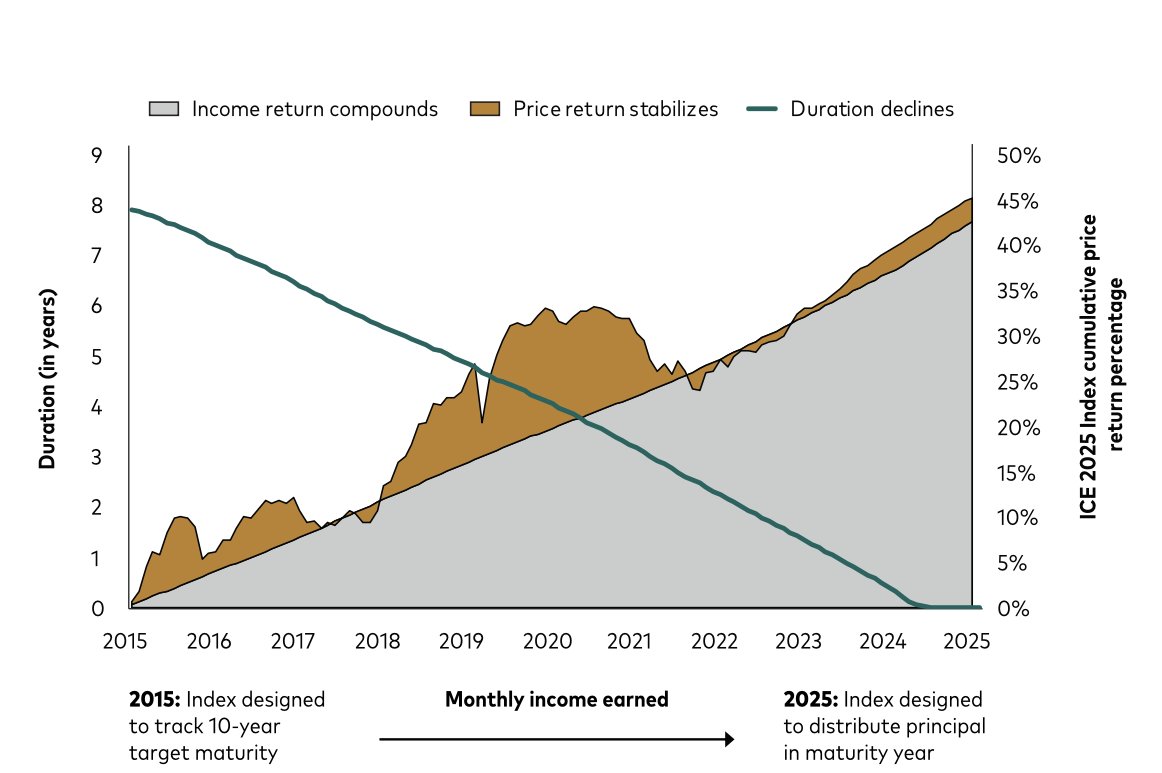
Most bond ladder ETF strategies are built around defined maturity dates, with each fund owning a diversified basket of bonds scheduled to mature during a particular calendar year. As bonds mature, proceeds are generally held in cash or short-term investments until the ETF reaches its stated termination date, at which point the fund liquidates and returns its net asset value to shareholders. As it turns out, the ride closely resembles owning an individual bond on that rung.
This chart highlights the return profile of the ICE 2025 Maturity U.S. Corporate Constrained Index, mimicking an individual bond over its lifespan.
Source: Vanguard
Innovations in active management and structure have moved beyond target-date bond ladder ETFs. Many bond ladder ETFs now roll their maturing bonds into bonds with later maturity dates in accordance with their mandates, removing the guesswork from rolling and reducing risk and complexity for individual investors.
Another emerging innovation is the all-in-one bond ladder ETF, which holds various maturities but distributes proceeds from maturing bonds to investors rather than rolling them over, directly addressing the challenge of liability matching.
Many investors know they will need money at specific points in the future. A retiree may anticipate annual living expenses not fully covered by Social Security, parents may be preparing for college tuition payments, and businesses, foundations, and endowments often have scheduled obligations requiring dependable funding. Rather than hoping market conditions cooperate when cash is needed, investors can align bond maturities with known future liabilities.
Integrating Bond Ladder ETFs Into a Portfolio
Bond ladder ETFs are not intended to replace every fixed-income allocation, but they can serve as valuable complements to traditional bond strategies.
Many investors may continue using broad core bond funds for diversified market exposure while adding bond ladder ETFs to fund known spending needs. This approach keeps the core portfolio invested for long-term total return while creating dedicated capital pools designed to mature when cash is required.
Another strategy combines bond ladder ETFs with actively managed bond funds. Active managers can pursue opportunities across sectors, credit quality, and duration, while a treasury or municipal bond ladder ETF provides predictable cash flow and maturity scheduling—offering both flexibility and structure within the same portfolio.
The growing popularity of bond ladder ETFs has attracted some of the largest names in asset management, reflecting rising demand for outcome-oriented fixed-income strategies. Today, BlackRock, State Street, Invesco, Northern Trust, and now Vanguard all offer products in this space.
Target Maturity and Bond Ladder ETFs
These ETFs represent a selection of target maturity and bond ladder ETFs within the corporate bond space and can serve as a starting point within an issuer’s franchise, with funds available above and below on the maturity timeline. Sorted by YTD total return, they range from 4.2% to 7.3%, carry expense ratios between 0.10% and 0.15%, assets under management of $11 million to $4.2 billion, and yields between 2.1% and 4.6%.
| Ticker | Name | AUM | YTD Total Ret (%) | Yield (%) | Exp Ratio | Security Type | Actively Managed? |
| MYCJ | SPDR SSGA My2030 Corporate Bond ETF | $21M | 7.3% | 4.6% | 0.15% | ETF | Yes |
| LDRC | iShares iBonds 1-5 Year Corporate Ladder ETF | $11.7M | 5.7% | 4.44% | 0.1% | ETF | Yes |
| BSCQ | Invesco BulletShares 2026 Corporate Bond ETF | $4.23B | 4.6% | 4.1% | 0.1% | ETF | Yes |
| IBDR | iShares iBonds Dec 2026 Term Corporate ETF | $3.36B | 4.2% | 2.14% | 0.1% | ETF | Yes |
Today’s fixed-income market offers some of the most attractive income opportunities investors have seen in years, yet it also presents meaningful challenges. Elevated interest rates, uncertain monetary policy, and ongoing volatility make it increasingly important to think strategically about how bonds are used within a portfolio, rather than simply allocating to a broad bond index.
Bond ladder ETFs offer a practical solution to many of these challenges. By combining diversified bond portfolios with defined maturity dates, they help investors create predictable cash flows, manage interest-rate and reinvestment risk, and align assets with future financial obligations. The commitment from industry leaders, including Vanguard, State Street, Northern Trust, Invesco, and BlackRock, underscores the growing demand for these outcome-oriented strategies.
Bottom Line
Whether used to fund retirement income, match future liabilities, or complement actively managed fixed-income strategies, bond ladder ETFs offer investors a flexible and efficient way to navigate today’s evolving bond market.