Senior loans—also known as leveraged loans or bank loans—have grown into a distinct and increasingly important asset class for income-focused investors. Their floating-rate structure, seniority in the capital stack, and relatively low duration make them compelling in environments of rising or volatile interest rates. However, senior loans also present practical constraints for investors: they are less liquid than traditional bonds, settle differently, and require skilled credit analysis to manage diversified exposure.
Closed-end funds (CEFs), however, were built precisely for challenges like these.
CEFs’ permanent capital structure enables managers to invest confidently in less liquid instruments, making them an ideal vehicle for senior loan strategies. By understanding how CEFs align naturally with the mechanics of senior loans, income-oriented investors can incorporate them into portfolios to capture attractive yields.
The Beauty Of Senior Loans
Senior and leveraged loans are a unique asset class in the world of fixed income. Thanks to the growth of private credit, these assets have exploded in issuance since the Great Recession. The asset type combines elements of junk bonds, Treasury inflation-protected securities (TIPS), and asset-backed securities into a single bond type.
Typically, these loans are issued to non-investment-grade companies and are used for various purposes, including leveraged buyouts, refinancing, recapitalizations, or corporate expansion. The “senior” in their name comes from the fact that these loans occupy the highest position in the borrower’s capital structure and have priority over bonds or equity in the event of default. To secure the loan, it is often backed by collateral, meaning the borrowers get the asset if a firm defaults.
The real win is that senior loans often have high starting yields and their coupons “float” with benchmark reference rates such as SOFR or other short-term rates. So, every 30 to 90 days, the interest rate a bank collects from the loan will change.
Because of their high yields and senior position, these loans have some of the highest risk-adjusted returns in fixed income. This chart from asset manager Nuveen highlights this potential.
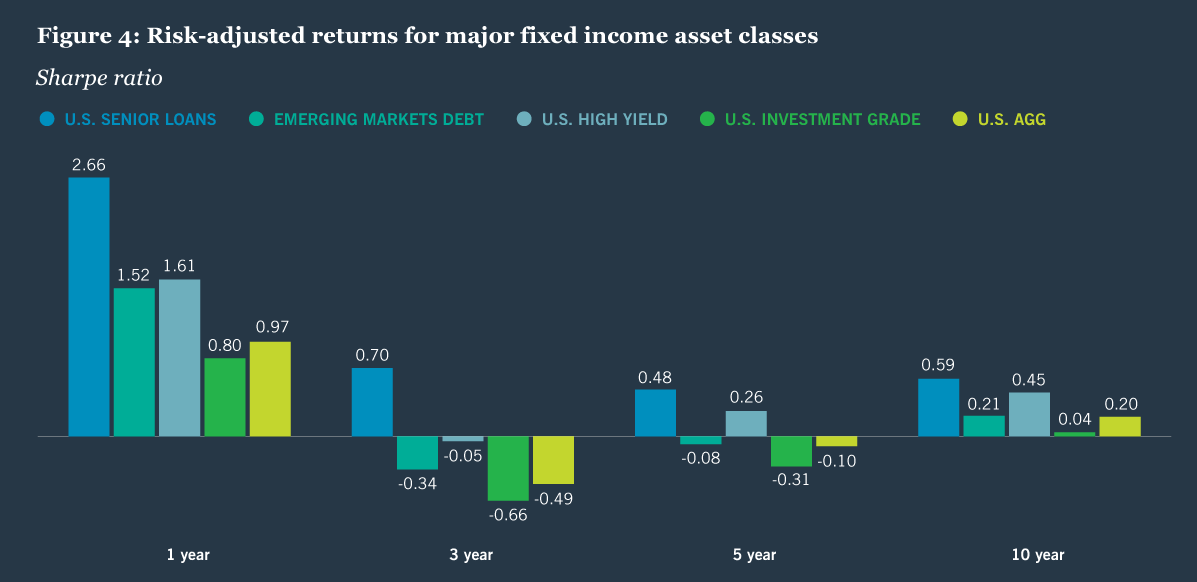
Source: Nuveen
Closed-End Funds Are Perfect for Senior Loans
Senior loans are excellent fixed-income assets to hold under various scenarios. However, senior loans tend to be less liquid than typical publicly traded bonds. They often settle on a delayed timetable and may be harder to trade in large blocks without price concessions. Additionally, senior loans often experience periods of reduced liquidity, particularly when broader markets face volatility. These structural challenges make them difficult to house in daily liquidity mutual funds, which may be forced to sell loans quickly if shareholders redeem shares.
Closed-end funds could be the answer.
Closed-end funds offer structural advantages that align almost perfectly with the characteristics of senior loans. A CEF issues a fixed number of shares during an initial public offering (IPO) and trades like a stock on an exchange. Because shares do not redeem daily, the manager never has to sell assets simply to meet redemptions. This permanent capital base allows the portfolio to be invested in less liquid or slower-settling instruments, such as senior loans, without worrying about sudden cash needs. Managers can ride through volatility, holding loans to maturity or until credit conditions improve, all while collecting their high yields.
Moreover, because senior loans are secured via collateral and often feature relatively stable cash flows, many CEF managers use structural leverage to magnify the income produced by the portfolio. This can boost already higher yields. Additionally, because these loans are floating-rate, using leverage can create a bigger income advantage when rates rise.
Using Senior-Loan CEFs for Income
Senior-loan CEFs provide income-oriented investors with access to one of the highest-yielding corners of the fixed-income universe, and using closed-end funds to purchase them is a no-brainer. Offering the ability to hold these bonds for the long haul and extract potentially higher yields via leverage, CEFs are a prime way to add senior loans to a portfolio.
And luckily, there are numerous ways to do just that. Several CEFs exist that focus strictly on senior loans, while others use them in concert with other high-yield and non-traditional bond types. This makes CEFs a perfect tool for a satellite income position in a portfolio.
Senior Loan & Floating Rate CEFs
These CEFs were selected based on their exposure to senior loans, leverage loans, and other non-investment-grade floating-rate debt. They have expense ratios between 1.6% and 5.5% and assets under management between $270M and $1.4B. They are currently yielding between 8.3% and 12.6%.
| Ticker | Name | AUM | YTD Total Ret (%) | Yield (%) | Exp Ratio | Security Type | Actively Managed? |
|---|---|---|---|---|---|---|---|
| XJFRX | Nuveen Floating Rate Income Fund | $1.4B | 6.06% | 11.7% | 2.2% | CEF | Yes |
| XFCTX | First Trust Senior Floating Rate Income Fund II | $270M | 5.4% | 11.3% | 1.7% | CEF | Yes |
| XBGTX | BlackRock Floating Rate Income Trust | $357M | 5.2% | 12.2% | 1.61% | CEF | Yes |
| XJQCX | Nuveen Credit Strategies Income Fund | $835M | 5.17% | 11.6% | 5.48% | CEF | Yes |
| XEFRX | Eaton Vance Senior Floating Rate Fund | $366M | 3.1% | 8.3% | 1.79% | CEF | Yes |
| XVVRX | Invesco Senior Income Trust | $561M | 2.4% | 12.6% | 2.13% | CEF | Yes |
Senior loans offer a compelling combination of high income, floating-rate protection, and secured credit exposure. However, their structural complexity and liquidity limitations make them difficult to access efficiently through daily liquid vehicles. Closed-end funds solve these challenges by giving managers permanent capital, flexible liquidity management, and the ability to fully invest in less liquid, higher-yielding segments of the loan market. Using the structure to gain access makes a lot of sense.
Bottom Line
Senior loans are excellent fixed-income vehicles. However, the lack of liquidity and the trade nature put off many investors. Closed-end funds are a great way to gain access to the fixed-income variety.