After years of unusually low interest rates, fixed-income is finally offering investors something missing for much of the past decade: attractive yields without excessive risk. Treasury bonds, investment-grade corporate debt, municipal securities, and shorter-duration bonds are all providing meaningful income opportunities, while higher starting yields have improved the potential for long-term returns.
However, simply purchasing a broad bond index may not be the best way to capitalize on this environment. The bond market has grown increasingly complex, shaped by persistent inflation, shifting Federal Reserve policy, elevated government borrowing, and changing credit conditions.
That’s where active ETFs come in. For investors willing to look beyond traditional benchmarks, these complexities could create opportunities to generate additional income while managing risk—and now may be the best time in years to go active.
A New Bond Regime
For much of the decade following the global financial crisis, interest rates remained exceptionally low, forcing investors seeking meaningful income to accept longer maturities, weaker credit quality, or greater exposure to volatile assets.
That environment has changed dramatically.
As of November 9, 2026, the benchmark 10-year Treasury yielded approximately 4.88%, compared with 4.11% a year earlier. The two-year Treasury offered 4.56%, while the 30-year Treasury yielded 5.26%.
The higher yields extend beyond government bonds. Investment-grade corporate bonds, municipal securities, high-yield debt, and securitized credit are all offering attractive yields across different credit and maturity profiles.
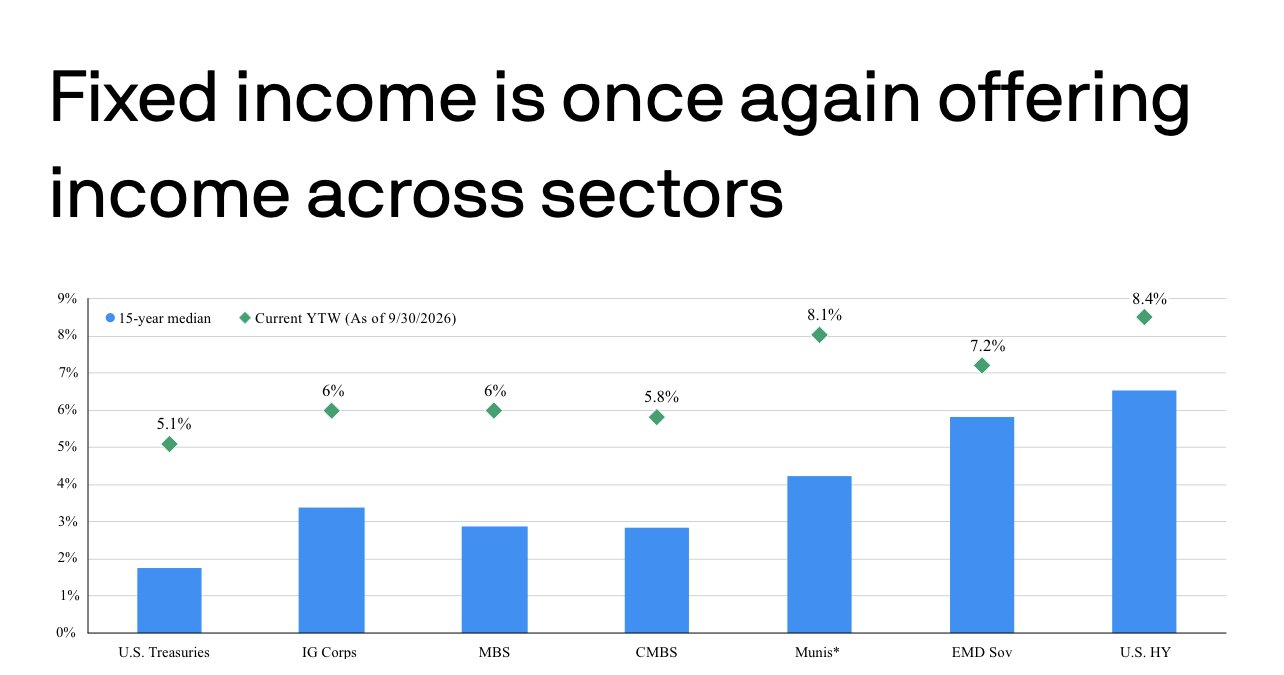
The broad investment-grade bond market currently yields approximately 6%, while selected investment-grade securities—including subordinated bank debt and hybrid corporate bonds—offer yields exceeding 7%. Even the municipal bond sector has become increasingly attractive, with tax-equivalent yields exceeding 8% for investors in higher tax brackets.
This chart from J.P. Morgan highlights the current yields available across fixed-income.
Source: J. P. Morgan
These higher yields have created some interesting opportunities.
J.P. Morgan Asset Management notes that the 10-year Treasury yield has spent less than 10% of the time above 5% during the 21st century, illustrating how unusual today’s income opportunities have become. 1
These opportunities suggest that investors no longer need to rely exclusively on equities or lower-quality bonds to pursue meaningful returns.
Historically, higher initial bond yields have been strongly associated with higher subsequent returns over longer holding periods.
J.P. Morgan research examining monthly observations beginning in January 1976 demonstrates a consistent relationship between starting yields and annualized five-year returns for core bonds.
The implication is straightforward: when investors purchase bonds at higher yields, the income received provides a stronger foundation for future total returns.
Why Active Bond ETFs Could Have an Advantage
The rub in J.P. Morgan’s study is that different fixed-income sectors can produce substantially different outcomes, with various factors driving performance across bond sectors.
The opportunity created by higher yields is particularly compelling for active fixed-income managers.
Traditional passive bond ETFs generally track indexes that weight securities according to the amount of debt outstanding. This means the largest borrowers often receive the greatest portfolio allocations, regardless of whether their bonds offer the most attractive yields or valuations.
The Bloomberg U.S. Aggregate Bond Index (Agg), for example, focuses on investment-grade, U.S. dollar-denominated taxable bonds, excluding significant portions of the fixed-income universe—including high-yield corporate bonds, leveraged loans, many emerging-market securities, and certain securitized credit investments. Roughly 49% of the U.S. bond market is excluded from the Agg, leaving passive strategies with limited scope to generate income.
Active bond ETFs may also help investors generate attractive income without automatically moving into the riskiest corners of the credit market.
J.P. Morgan highlights opportunities within investment-grade credit, including subordinated bank debt, utility hybrid securities, and selected technology-related corporate bonds, which can offer additional yield compared with conventional investment-grade benchmarks.
For investors holding substantial cash balances, short-duration active bond ETFs may provide opportunities to earn additional income without assuming the volatility associated with long-duration securities.
Active bond ETFs can also provide diversification benefits that passive indexes cannot match. Active multi-sector bond ETFs can combine government bonds, investment-grade corporate debt, mortgage-backed securities, asset-backed securities, high-yield bonds, and emerging-market debt within a single portfolio.
These securities respond differently to changes in interest rates, economic growth, and credit conditions. Treasury bonds may perform well during downturns as investors seek safety, while high-yield bonds generally benefit from stronger economic conditions and improving corporate profitability. By adjusting allocations among sectors, active managers can balance income opportunities with portfolio diversification.
Active managers can evaluate whether the additional income adequately compensates investors for those risks.
These benefits could prove invaluable for investors in the current environment.
Replacing Passive Bond ETFs With Active Strategies
Investors interested in active fixed-income don’t necessarily need to abandon passive bond ETFs entirely.
Instead, they can evaluate whether an active strategy provides meaningful advantages over their existing holdings. The iShares Core U.S. Aggregate Bond ETF (AGG) and Vanguard Total Bond Market ETF (BND) remain useful low-cost options for broad investment-grade bond exposure.
Investors seeking greater flexibility could consider adding active bond ETFs to their mix for greater exposure and income potential.
Active Bond ETFs
These ETFs offer low-cost exposure to active bond management across various sectors. Sorted by YTD return—from -2.8% to 9.1%—they carry expenses of 0.10%–0.65%, assets of $51M–$23B, and yields of 4.2%–7.1%.
| Ticker | Name | AUM | YTD Total Ret (%) | Yield (%) | Exp Ratio | Security Type | Actively Managed? |
|---|---|---|---|---|---|---|---|
| BOND | PIMCO Active Bond ETF | $6.6B | 9.1% | 5.0% | 0.56% | ETF | Yes |
| JCPB | JPMorgan Core Plus Bond ETF | $8.8B | 8.7% | 5.30% | 0.40% | ETF | Yes |
| OBND | SPDR Loomis Sayles Opportunistic Bond ETF | $51M | 8.10% | 6.8% | 0.55% | ETF | Yes |
| FBND | Fidelity Total Bond ETF | $22B | 7.9% | 4.9% | 0.36% | ETF | Yes |
| VCRB | Vanguard Core Bond ETF | $3B | 7.85% | 4.20% | 0.10% | ETF | Yes |
| TOTL | SPDR DoubleLine Total Return Tactical ETF | $4B | 7.84% | 5.1% | 0.55% | ETF | Yes |
| DBND | DoubleLine Opportunistic Bond ETF | $600M | 7.6% | 5% | 0.45% | ETF | Yes |
| BINC | BlackRock Flexible Income ETF | $14B | 7.59% | 5.5% | 0.52% | ETF | Yes |
| VPLS | Vanguard Core Plus Bond ETF | $138M | 3.3% | 4.6% | 0.2% | ETF | Yes |
| MINT | PIMCO Enhanced Short Maturity Active ETF | $9.7B | 2.2% | 5.1% | 0.35% | ETF | Yes |
| AVIG | Avantis Core Fixed-Income ETF | $1B | 2.2% | 5% | 0.15% | ETF | Yes |
| HYDB | iShares High Yield Systematic Bond ETF | $600M | 2% | 7.1% | 0.35% | ETF | No |
| JPST | JPMorgan Ultra Short Income ETF | $22.8B | 1.9% | 5.4% | 0.18% | ETF | Yes |
| IMNU | iShares Intermediate Muni Income Active ETF | $919M | 1.7% | 3.6% | 0.41% | ETF | Yes |
| HMOP | Hartford Municipal Opportunities ETF | $576M | 1.7% | 3.5% | 0.29% | ETF | Yes |
| CGMU | Capital Group Municipal Income ETF | $3.36B | 1.6% | 3.9% | 0.27% | ETF | Yes |
| DFCF | Dimensional Core Fixed-Income ETF | $3.35B | -1.3% | 5.0% | 0.19% | ETF | Yes |
| FIXD | First Trust TCW Opportunistic Fixed-Income ETF | $4.4B | -2.8% | 4.4% | 0.65% | ETF | Yes |
Today’s higher interest-rate environment has restored fixed-income as an attractive source of income, diversification, and potential long-term returns. With Treasury yields near multi-decade highs and opportunities spanning corporate bonds, municipal debt, and securitized credit, investors have more ways to generate meaningful income without relying exclusively on equities.
Active bond ETFs may be well-positioned to capitalize on this environment by moving beyond traditional index limitations, adjusting portfolio duration, and identifying attractive securities across credit sectors. Although passive bond ETFs remain valuable low-cost investments, incorporating active strategies could help investors improve diversification, enhance income potential, and manage changing market risks.
Bottom Line
With bond yields near multidecade highs and attractive opportunities emerging across fixed-income markets, now could be an ideal time for investors to embrace active bond ETFs.
1 JP Morgan (October 2026). Embrace today’s bond market: Investing in a higher interest rate environment