The ETF market has entered a new phase. Passive index strategies once dominated it. ETFs now serve as a primary vehicle for sophisticated active management. BlackRock’s recent launch of two new active ETFs—BDYN and BDVL—illustrates this shift. These originated as long-standing mutual funds in the firm’s Global Allocation suite.
This move exceeds a simple product repackage.
It marks a strategic inflection point for the active ETF movement, signalling that the ETF structure increasingly serves as the preferred method for multi-asset, dynamically managed solutions. BlackRock underscores the growing importance of global allocation strategies and the ETF wrapper’s advantages for them.
A Look at the New Funds
Global allocation funds have long served as staples in mutual funds and separately managed accounts (SMAs). They represent an active bet on global assets. These funds dynamically allocate across asset classes—equities, fixed-income, and alternatives. They adjust exposures based on macroeconomic conditions, valuations, and risk environments. Managers consider various factors and allocate accordingly.
BlackRock excels in global allocation, with the firm controlling more than $50 billion in assets on its global allocation platform. Its Global Allocation Fund (MDLOX) ranks among the planet’s largest mutual funds.
As asset management evolves, BlackRock changes its global allocation suite. It converts two flagship funds—the BlackRock GA Dynamic Equity Fund and BlackRock GA Disciplined Volatility Equity Fund—into new active ETFs.
Those mutual funds become the iShares Dynamic Equity Active ETF (BDYN) and iShares Disciplined Volatility Equity Active ETF (BDVL). They follow previous mandates. BDYN, an unconstrained global equity fund, seeks total return across regions, countries, and sectors. BDVL pursues a similar mandate but focuses on lower-volatility stocks. The funds hold over $1 billion in assets. 1
Global Allocation Is Ripe for Active ETF Investing
BlackRock’s conversion of these mutual funds to active ETFs makes sense. Global allocation suits active management by definition, with ETFs having the potential to enhance these strategies.
Global allocation demands decisions across regions, asset classes, currencies, and risks—unlike single-asset strategies. While static allocations fail to match shifting macro conditions, active strategies adapt to shifting correlations and opportunities. Investors can reduce losses and capture extra alpha.
The current market amplifies the need for portfolio flexibility. Inflation, interest-rate uncertainty, geopolitical issues, and divergent regional growth make traditional diversification less reliable. Stock-bond correlations shift. Sectors and regions compete for leadership. Valuation gaps widen. Rigid allocations expose investors to unintended risks.
Tax efficiency stands out. The in-kind creation and redemption mechanism defines ETFs. It helps manage capital gains better than mutual funds do. For strategies that rebalance across asset classes, this improves after-tax outcomes in taxable accounts. Morningstar estimates 17% capital gains exposure for MDLOX. An ETF minimizes this, potentially to 0%.
ETFs also offer cost efficiency and operational simplicity. Active ETFs have higher expense ratios than passive ones but cost less than mutual funds. They attract investors who want active management with structural benefits. Lower fees boost returns. Global allocation mutual funds often underperform because fees erode alpha. This is where ETFs can let investors profit from these strategies.
Implications for Investors
The launch of BDYN and BDVL signals broader changes in asset management. Investors demand strategies that blend flexibility, diversification, and efficiency. Rising market complexity makes passive approaches less effective in some segments.
BlackRock redefines active ETFs by moving established global allocation strategies into them. These products now deliver comprehensive, multi-asset solutions as core holdings. They extend beyond narrow factors or niches. This shift could drive future active ETF launches and assets.
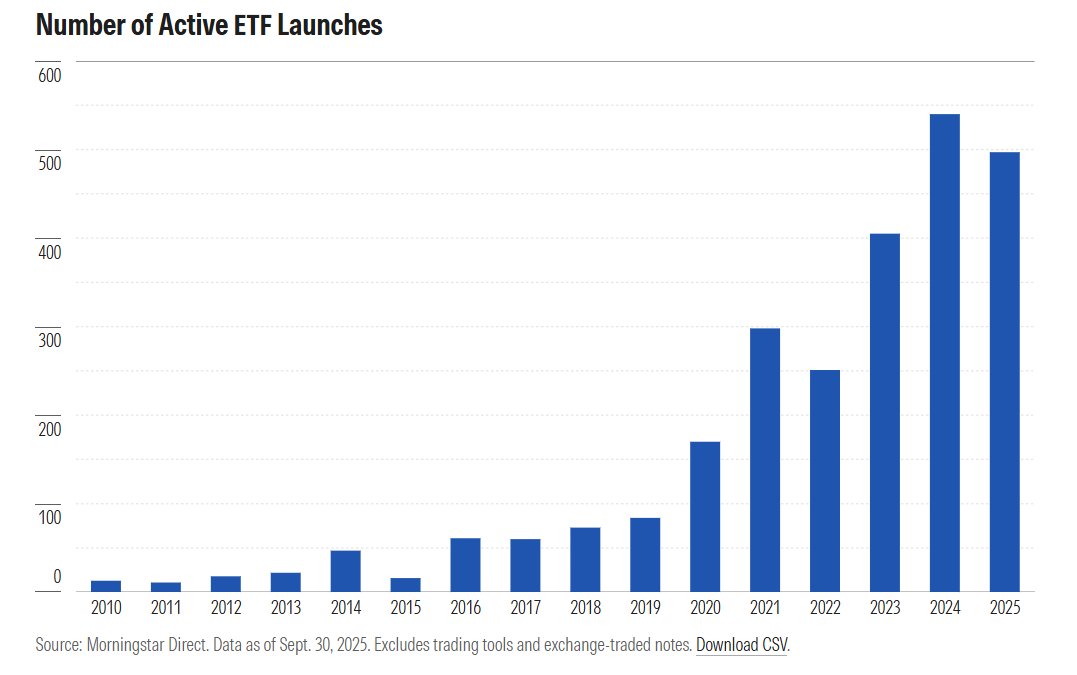
This Morningstar chart shows active ETF launches stalled this year. Major players with large global allocation suites—like J.P. Morgan, Goldman Sachs, and Fidelity—suggest the next growth wave nears.
Source: Morningstar
Popular Active ETFs
These ETFs show YTD total returns from 3.1% to 18.4%. Expense ratios range from 0.17% to 0.70%. Assets under management span $500 million to $42 billion. Yields fall between 0% and 9.7%.
| Ticker | Name | AUM | YTD Total Ret (%) | Yield (%) | Exp Ratio | Security Type | Actively Managed? |
|---|---|---|---|---|---|---|---|
| CGGR | Capital Group Growth ETF | $16.7B | 18.4% | 0.4% | 0.39% | ETF | Yes |
| FBCG | Fidelity Blue Chip Growth ETF | $4.9B | 15.5% | 0.5% | 0.60% | ETF | Yes |
| TCHP | T. Rowe Price Blue Chip Growth ETF | $1.6B | 15.1% | 0% | 0.57% | ETF | Yes |
| DFAC | Dimensional U.S. Core Equity 2 ETF | $38.4B | 11.3% | 0.8% | 0.17% | ETF | Yes |
| JEPQ | J.P. Morgan Nasdaq Equity Premium Income ETF | $30.9B | 11.4% | 9.7% | 0.35% | ETF | Yes |
| DFUV | Dimensional U.S. Marketwide Value ETF | $12.3B | 9.2% | 1.5% | 0.21% | ETF | Yes |
| FBND | Fidelity Total Bond ETF | $21.1B | 7.2% | 4.9% | 0.36% | ETF | Yes |
| HYBL | SPDR Blackstone High Income ETF | $511M | 5.6% | 8.2% | 0.70% | ETF | Yes |
| JEPI | JPMorgan Equity Premium Income ETF | $41.3B | 5.4% | 7.4% | 0.35% | ETF | Yes |
| JPST | JPMorgan Ultra Short Income ETF | $34.1B | 4.4% | 5.2% | 0.18% | ETF | Yes |
| AVUV | Avantis U.S. Small-Cap Value ETF | $18.6B | 4.1% | 1.4% | 0.25% | ETF | Yes |
| MINT | PIMCO Enhanced Short Maturity Active ETF | $14B | 4.1% | 5.3% | 0.35% | ETF | Yes |
| DFAT | Dimensional U.S. Targeted Value ETF | $11.6B | 3.1% | 0.8% | 0.28% | ETF | Yes |
BlackRock shows confidence in the ETF structure and active management by converting proven mutual fund strategies. Markets now demand flexibility, diversification, and dynamic risk management. Global allocation strategies gain relevance. ETFs prove ideal for delivery.
Bottom Line
Global allocation active ETFs have arrived. BlackRock’s recent conversions of two mutual funds to ETFs launch the next wave of active ETF growth: all-in-one strategies that span asset classes with active management. This development benefits investors’ portfolios.
1 BlackRock (October 2025). BlackRock Debuts Active ETFs from Its Global Allocation Franchise
Social Media
Active ETFs enter a new era as BlackRock brings its flagship global allocation strategies into the ETF wrapper. Multi-asset active management becomes more flexible, efficient, and central to modern portfolios.
Learn more about BlackRock’s global allocation strategies here. LINK