Investors today are navigating one of the most complex macroeconomic environments in decades. Shifting monetary policy, geopolitical tensions, uneven economic growth, and stubborn inflation have created a market landscape where traditional playbooks are less reliable. In prior periods, investors could rely on broad index exposure and steady global growth to carry portfolios higher. Today, however, risks are more fragmented and outcomes more uncertain.
This environment is increasingly highlighting the benefits of active management.
When markets become more volatile and dispersion between winners and losers increases, the ability to adapt becomes valuable. Active managers can shift allocations, manage risk exposures, and capitalize on mispricing opportunities that passive strategies must accept. At the same time, the exchange-traded fund (ETF) structure has emerged as one of the most efficient ways to deliver active strategies to investors.
A Market Filled With Crosscurrents
The current investment landscape is defined by a series of overlapping risks pulling markets in different directions, increasing uncertainty and complexity in both day-to-day trading and long-term investment decisions.
The economic environment is grinding slowly ahead. While not stalling, data shows signs of slowing in several key areas. Some indicators point to resilience, particularly in labor markets and consumer spending, while others suggest weakening momentum. Manufacturing activity has softened in several regions, and business investment is growing more cautious as companies await greater clarity on global demand.
The interest rate picture is also mixed. While many central banks have begun or are considering rate cuts, the path forward is far from clear. Inflation remains elevated and above central bank targets in several economies, forcing policymakers to balance growth concerns with price stability. As a result, rate expectations are shifting frequently, creating volatility in both equity and bond markets.
Geopolitical tensions are once again rising, introducing potential shocks that markets must constantly digest. Tensions in Iran, for example, have raised concerns about disruptions to global energy markets and shipping routes. Even the possibility of conflict escalation can affect oil prices, transportation costs, and broader inflation expectations, with sudden price spikes rippling through the global economy.
This uncertain backdrop is further complicated by high asset valuations in certain parts of the market. According to Goldman Sachs, a wide range of asset classes and market regions now feature elevated valuations compared with just a year ago. This chart from the investment highlights the stretched asset view.
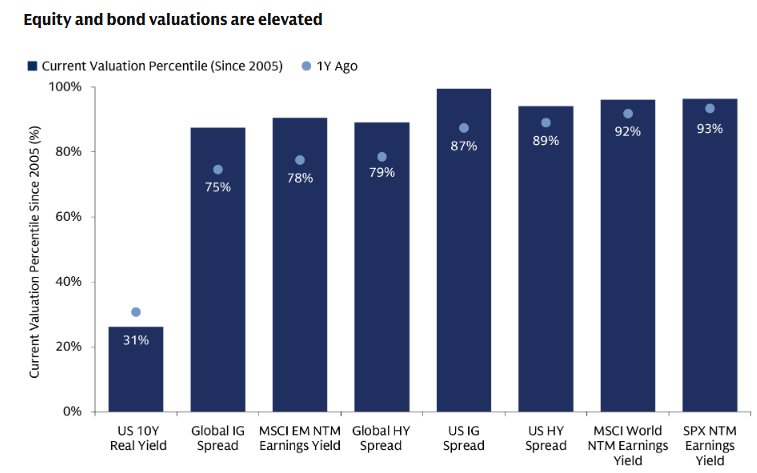
Source: Goldman Sachs
Taken together, these factors create a highly complex environment where broad market exposure alone may not be sufficient to manage risk or capture opportunity, leaving index investors at the mercy of overall market sentiment.
Active Management Has an Advantage
Active management can play an important role in navigating these concerns and mitigating growing risks.
Periods of economic and geopolitical uncertainty tend to increase dispersion across markets. Some sectors thrive while others struggle, certain regions outperform while others lag, and within fixed-income, credit quality and duration positioning become critical factors in determining returns.
Active managers are not constrained by the rigid rules that govern index-based strategies. Rather than holding every company or bond in an index regardless of market conditions, they can make deliberate allocation decisions—reducing exposure when risks rise in certain sectors or regions and increasing allocations when opportunities emerge in overlooked areas.
During periods of geopolitical tension affecting energy markets—such as today—active managers may tilt portfolios toward energy producers or infrastructure companies that benefit from higher commodity prices. If economic data begins to deteriorate, managers may shift toward defensive sectors, such as healthcare or utilities.
Active fixed-income managers can also add value by adjusting duration exposure, credit risk, and sector allocations. In a mixed interest rate environment, these decisions can significantly influence performance; for instance, a manager may favor short-duration credit over long-term government bonds if inflation risks remain elevated.
Another advantage of active management is the ability to manage concentration risk. Many major equity indexes today are heavily weighted toward a handful of mega-cap companies, but active managers can reduce that exposure and diversify portfolios more broadly across sectors and market capitalizations.
Perhaps most importantly, active management is not simply about making bold predictions. Often, the greatest value comes from risk management—avoiding major drawdowns, identifying deteriorating fundamentals early, and maintaining flexibility as conditions evolve.
ETFs Are the Ideal Vehicle for Active Strategies
While active management offers potential advantages in complex markets, the delivery mechanism matters. Historically, active strategies were primarily available through mutual funds or separately managed accounts, but the rapid growth of active ETFs has transformed how investors can access these strategies.
Holdings transparency and daily share liquidity are key drivers of active ETFs, offering meaningful benefits to investors in this kind of environment. Combined with potential tax savings, these features make a compelling case for the structure.
Popular Active ETFs
These ETFs, sorted by YTD total returns (3.1% to 18.4%), carry expense ratios of 0.17% to 0.70% and assets under management from $500 million to $42 billion, with current yields ranging from 0% to 9.7%.
| Ticker | Name | AUM | YTD Total Ret (%) | Yield (%) | Exp Ratio | Security Type | Actively Managed? |
|---|---|---|---|---|---|---|---|
| CGGR | Capital Group Growth ETF | $16.7B | 18.4% | 0.4% | 0.39% | ETF | Yes |
| FBCG | Fidelity Blue Chip Growth ETF | $4.9B | 15.5% | 0.5% | 0.60% | ETF | Yes |
| TCHP | T. Rowe Price Blue Chip Growth ETF | $1.6B | 15.1% | 0% | 0.57% | ETF | Yes |
| JEPQ | J.P. Morgan Nasdaq Equity Premium Income ETF | $30.9B | 11.4% | 9.7% | 0.35% | ETF | Yes |
| DFAC | Dimensional U.S. Core Equity 2 ETF | $38.4B | 11.3% | 0.8% | 0.17% | ETF | Yes |
| DFUV | Dimensional U.S. Marketwide Value ETF | $12.3B | 9.2% | 1.5% | 0.21% | ETF | Yes |
| FBND | Fidelity Total Bond ETF | $21.1B | 7.2% | 4.9% | 0.36% | ETF | Yes |
| HYBL | SPDR Blackstone High Income ETF | $511M | 5.6% | 8.2% | 0.70% | ETF | Yes |
| JEPI | JPMorgan Equity Premium Income ETF | $41.3B | 5.4% | 7.4% | 0.35% | ETF | Yes |
| JPST | JPMorgan Ultra Short Income ETF | $34.1B | 4.4% | 5.2% | 0.18% | ETF | Yes |
| AVUV | Avantis U.S. Small-Cap Value ETF | $18.6B | 4.1% | 1.4% | 0.25% | ETF | Yes |
| MINT | PIMCO Enhanced Short Maturity Active ETF | $14B | 4.1% | 5.3% | 0.35% | ETF | Yes |
| DFAT | Dimensional U.S. Targeted Value ETF | $11.6B | 3.1% | 0.8% | 0.28% | ETF | Yes |
Looking ahead, the global investment environment is unlikely to simplify. Geopolitical tensions, shifting growth patterns, evolving central bank policies, and technological disruptions will continue to shape markets.
In such an environment, flexibility and adaptability may grow increasingly valuable for investors. Active management offers the ability to respond to changing conditions, while the ETF structure enhances transparency, liquidity, and cost efficiency.
Bottom Line
For investors navigating today’s complex markets, active ETFs may represent one of the most effective tools available. By combining professional portfolio management with the structural advantages of the ETF wrapper, these strategies can help investors stay invested while managing risk and capturing opportunities across an uncertain global landscape.