With risk growing across a variety of channels, investors are once again turning to long-term standards in portfolio allocation and strategy. High on that list are dividends. These steady cash payments can reduce risk, boost returns, and smooth out a portfolio’s ride. However, not all dividend payers feature low risk, which is worth considering in today’s higher-risk environment.
This is where active management comes in.
Dividend growth strategies may perform best with an active manager at the helm, giving investors the security and income they need while still delivering long-term returns.
Dividend Growth Is About More Than Yield
For many investors and even some financial advisors, dividend investing is often associated with one simple objective: generating income. Headline yield and the ability to collect it every quarter help drive returns, meet end goals, and ultimately help investors prosper.
However, some of the strongest long-term performers in the equity market have not necessarily been the companies paying the biggest dividends. Instead, they have been businesses capable of consistently growing those dividends.
That distinction matters.
A company that increases its dividend year after year generally needs growing earnings, healthy free cash flow, a solid balance sheet, and a management team willing to return capital to shareholders. In that sense, dividend growth can function as a quality screen, helping investors identify financially strong businesses capable of growing both earnings and shareholder distributions over time.
The historical record is compelling.
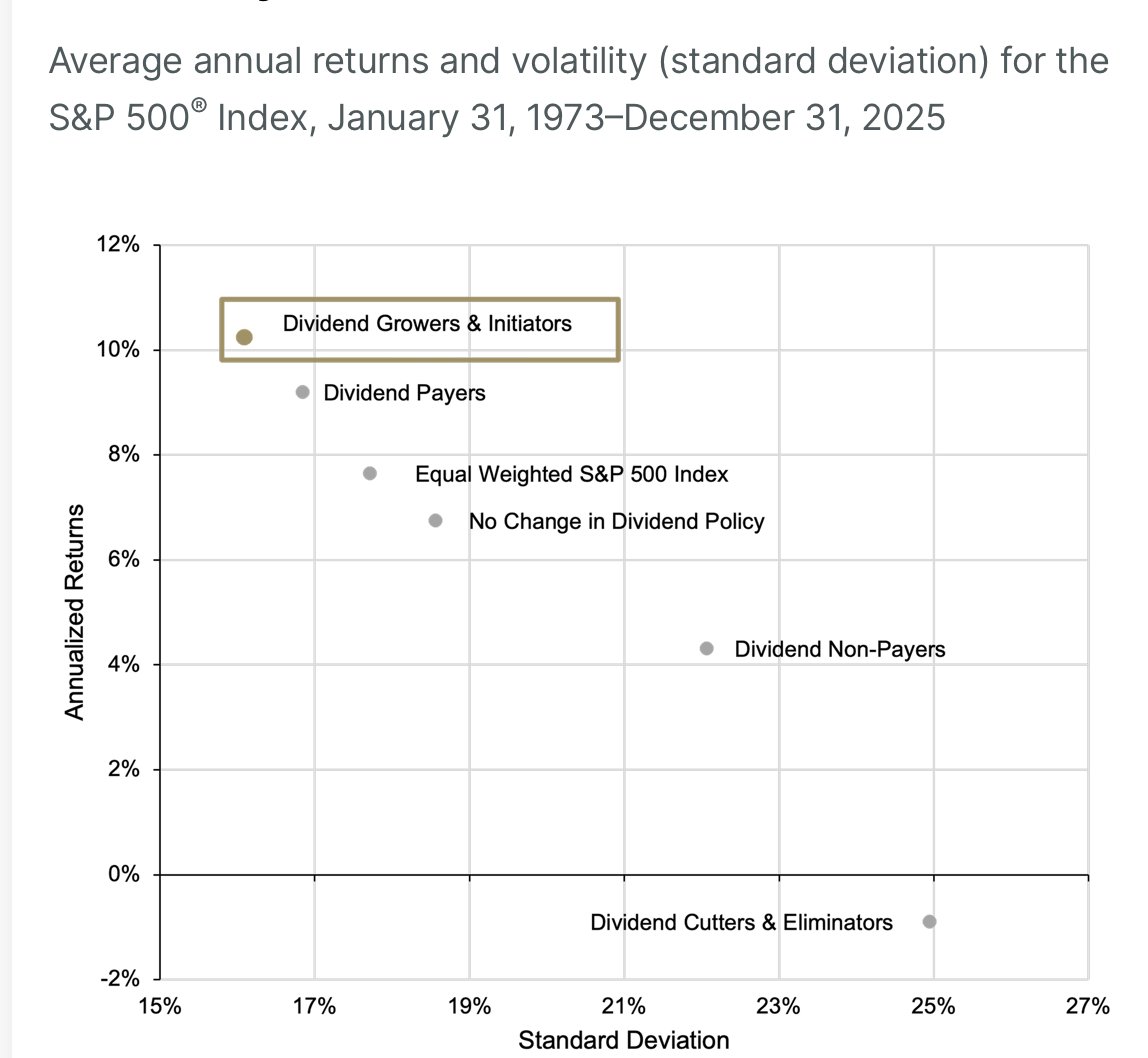
Research cited by Lord Abbett covering January 1973 through December 2025 found that S&P 500 companies that grew or initiated dividends produced higher annualized returns with lower volatility than companies that maintained dividends, paid no dividends, or cut them. 1
This chart from the asset manager summarizes the research and compares dividend growers with various other payers and non-payers.
Source: State Street Global
Today’s environment makes these characteristics particularly valuable. Equity valuations remain elevated, geopolitical uncertainty is significant, and questions surrounding enormous AI capital expenditures have increased the importance of actual cash generation. Meanwhile, persistent inflation makes a growing income stream more attractive than a static one.
Not All Dividend Stocks Are Created Equal
On the surface, dividend growth seems tailor-made for passive management. Establish a few rules—perhaps 10 consecutive years of dividend increases, a minimum yield, and certain liquidity requirements—and buy every qualifying company.
There is nothing inherently wrong with that approach, and several successful funds and ETFs track this idea. However, rigid rules can produce some strange outcomes.
Passive dividend-growth indexes frequently require companies to have increased distributions for a predetermined number of consecutive years. A fundamentally healthy company that temporarily pauses its dividend increase—due to a mega-merger, a transformative acquisition, or a worldwide crisis—can be automatically removed. Meanwhile, a rapidly improving business that recently began raising its dividend may have to wait years before becoming eligible.
For example, TJX Companies Inc temporarily paused dividend growth during the extraordinary disruption caused by COVID-19, which was a prudent move given the unknowns surrounding the pandemic. Similarly, pharmaceutical company Eli Lilly and Co had strong dividend growth for years but fell just short of the length requirements for many dividend indexes.
Passive strategies could interpret these events as grounds to exclude such companies from their indexes.
Active management works differently. An active manager can ask, “Does this company have the ability and willingness to increase its dividend for years to come?” rather than relying on backward-looking rules. By analyzing earnings growth, cash flow sustainability, balance sheet strength, and competitive positioning, active managers can identify companies not only paying dividends today but well-positioned to grow them in the future.
This approach matters for returns. Morningstar’s latest active/passive barometer shows that active dividend managers hold a slight edge over their passive counterparts, confirming that the flexibility to find opportunities outside major dividend growth indexes does work.
ETFs Are Changing the Dividend Growth Playbook
Historically, investors seeking active dividend management had two choices: select individual stocks themselves or purchase an actively managed mutual fund.
Active ETFs have created another option.
The ETF structure allows investors to combine professional security selection with many of the features that made passive ETFs popular, including intraday liquidity and generally competitive expenses. Tax efficiency is a bonus: managers can select firms whose payouts meet IRS standards for qualified dividends, while the ETF creation-redemption mechanism can help avoid capital gains when a manager sells a position.
Active Dividend ETFs
These ETFs were selected based on their exposure to dividend stocks with an active touch. The list is sorted by YTD total return, which ranges from 13% to 20%. Expense ratios fall between 0.33% and 1.97%, assets under management range from $8M to $7B, and current yields range from 1.5% to 2.5%.
| Ticker | Name | AUM | YTD Total Ret (%) | Yield (%) | Exp Ratio | Security Type | Actively Managed? |
|---|---|---|---|---|---|---|---|
| HIDV | AB U.S. High Dividend ETF | $12.4M | 19.7% | 2% | 0.45% | ETF | Yes |
| CGDV | Capital Group Dividend Value ETF | $7.04B | 18.6% | 1.5% | 0.33% | ETF | Yes |
| JHDV | John Hancock U.S. High Dividend ETF | $8.2M | 16.6% | 2.5% | 1.97% | ETF | Yes |
| TEQI | T. Rowe Price Equity Income ETF | $158M | 13% | 1.6% | 0.54% | ETF | Yes |
Active International Dividend ETFs
These ETFs were selected based on their exposure to international dividend stocks with an active management approach. Sorted by YTD total return, they range from 6% to 22%, with expense ratios between 0.32% and 2.81%, assets under management of $3M to $716M, and current yields between 2.3% and 12.6%.
| Ticker | Name | AUM | YTD Total Ret (%) | Yield (%) | Exp Ratio | Security Type | Actively Managed? |
|---|---|---|---|---|---|---|---|
| INEQ | Columbia International Equity Income ETF | $7.85M | 22.2% | 5% | 0.46% | ETF | Yes |
| IDVO | Amplify CWP International Enhanced Dividend Income ETF | $178M | 17.4% | 6% | 0.66% | ETF | Yes |
| ADVE | Matthews Asia Dividend Active ETF | $3.2M | 12.2% | 2.3% | 0.79% | ETF | Yes |
| DGRE | WisdomTree Emerging Markets Quality Dividend Growth Fund | $128M | 11.3% | 2.5% | 0.32% | ETF | Yes |
| BIDD | iShares International Dividend Active ETF | $716M | 11.1% | 4.5% | 0.61% | ETF | Yes |
| JHID | John Hancock International High Dividend ETF | $8M | 6% | 12.6% | 2.81% | ETF | Yes |
Dividend growth investing has one of the more compelling long-term records among equity strategies, combining income with quality characteristics that can support capital appreciation and reduce volatility. The current environment of elevated valuations, persistent inflation, geopolitical uncertainty, and growing scrutiny of corporate spending could make those characteristics even more valuable.
The strongest opportunities, however, are not necessarily found by mechanically selecting companies with the longest dividend histories or highest yields.
Active managers can evaluate balance sheets, cash flows, payout sustainability, and future earnings potential while identifying tomorrow’s dividend leaders before they qualify for rigid passive indexes—and active ETFs are the key to making this approach work.
Bottom Line
With active ETFs making a research-driven approach more accessible and efficient, dividend growth investors have a growing opportunity to pursue not just more income today, but more income tomorrow—and potentially stronger total returns along the way.
1 Lord Abbett (June 2026). Dividend Growth Investing: A Focus on Flexibility and Selectivity