For investors looking to diversify beyond an increasingly concentrated U.S. market, international stocks have begun attracting renewed attention. It’s easy to see why. Lower valuations, higher dividends, and less tech exposure are hallmarks of going global these days. With that, billions have flowed into international funds and ETFs.
However, buying an international index isn’t necessarily the same as finding the most attractive businesses overseas.
A company’s headquarters tells investors where it is incorporated, but says much less about where it earns its revenue, how effectively it competes, or whether its business can adapt to the economic changes reshaping global markets. This is why active management—and increasingly, active ETFs—are the way to go global in today’s marketplace.
International Stocks Are Getting a Second Look
For much of the past two decades, U.S. equities dominated global markets. American technology companies delivered exceptional earnings growth, attracting capital from investors worldwide, while international stocks frequently struggled to keep pace.
That dynamic has started changing.
According to investment manager Lord Abbett, earnings growth outside the U.S. has largely caught up with U.S. earnings growth since the beginning of 2025, driven by investment in artificial intelligence (AI), industrial capacity, power infrastructure, aerospace, and defense.
The performance reflects that improvement. Through August 11, 2026, the MSCI ACWI ex-USA Index returned 16.0%, compared with 13.7% for the S&P 500.
The underlying earnings picture is equally interesting. Lord Abbett’s analysis shows that U.S. earnings-per-share growth substantially exceeded international growth in 2024, but the two markets converged during 2025, with estimates for 2026 putting earnings growth for both indexes near 30%.
This chart from the asset manager highlights the continued improvement in EPS gains for international firms.
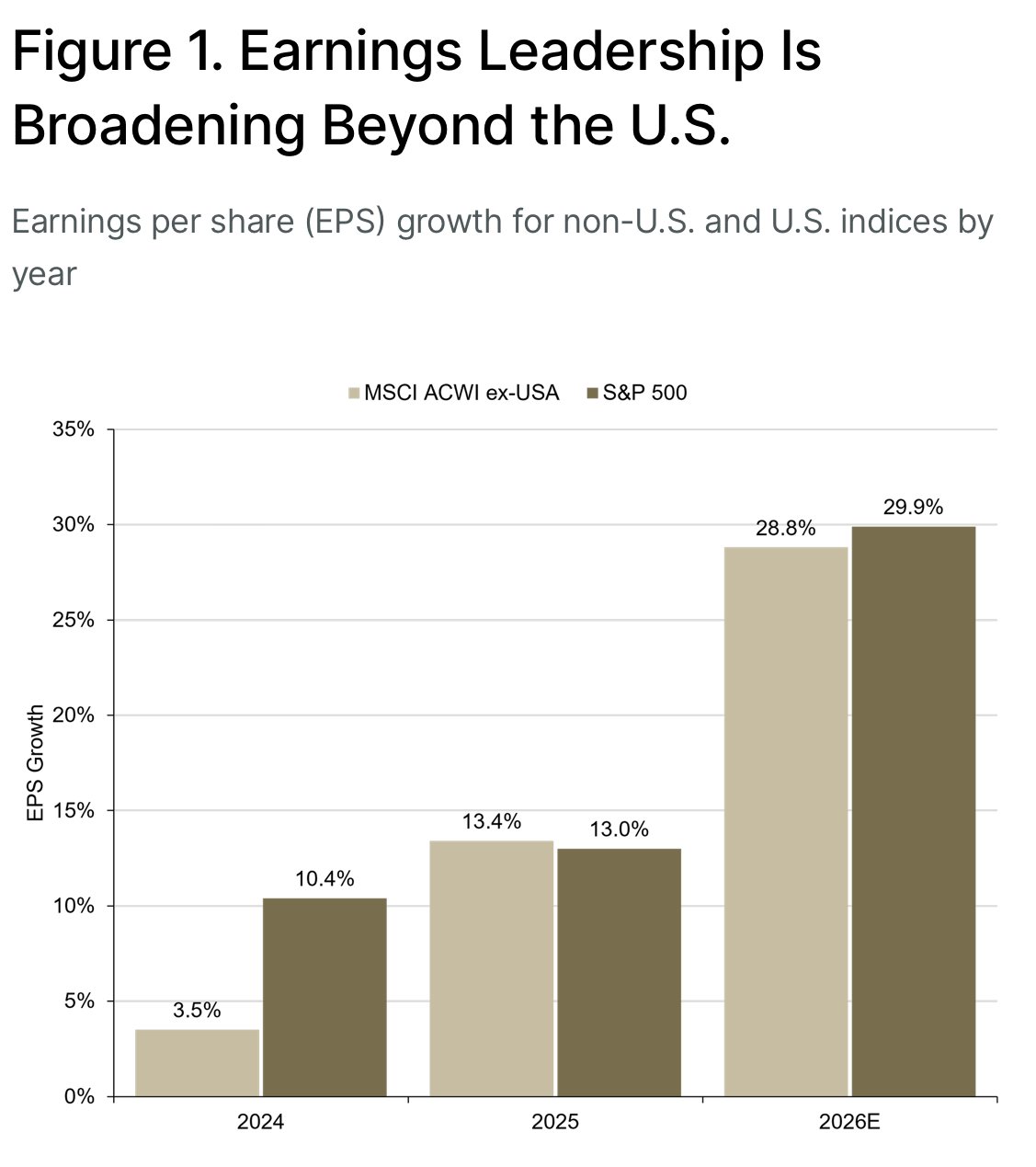
Source: Lord Abbett
That suggests investors no longer need to rely exclusively on American companies to find attractive growth.
Countries Don't Determine Competitive Advantage
Buying an international index introduces a potential limitation: investors gain exposure according to the benchmark’s construction, not necessarily according to the strength of individual businesses.
That is where active management becomes interesting.
Most traditional international equity indexes are weighted by market capitalization, so countries with larger publicly traded markets receive larger allocations and individual companies are weighted by their market values.
That provides inexpensive, diversified exposure, but it doesn’t necessarily direct capital toward companies with the strongest competitive positions.
An index might hold substantial Japanese, British, or French equities because those markets represent large portions of its benchmark, without distinguishing whether a particular company has a superior business model, attractive reinvestment opportunities, or a sustainable competitive advantage.
Active managers can make those distinctions.
Lord Abbett argues that successful international investing ultimately comes down to understanding what makes an individual company difficult to compete with—a quality called durable advantage—which gives international investors a way to compare companies across borders.
Instead of starting with a country allocation and filling it with companies, active managers can identify businesses capable of sustaining attractive returns and then determine whether their valuations justify an investment.
The country still matters, as political conditions, regulation, currencies, and economic growth can all influence corporate profitability. However, geography becomes one consideration rather than the primary determinant of portfolio construction.
Active managers can examine distinctions company by company, seeking businesses with the financial strength and competitive positioning to translate technological change into sustainable earnings growth—without being constrained by a country’s benchmark weight.
The proof is in the pudding. Active managers in international stocks have long enjoyed a return advantage over passive indexes and score well on Morningstar’s active/passive barometer.
ETFs Make Active International Investing More Accessible
Historically, investors seeking active international exposure often relied on traditional mutual funds or separately managed accounts.
The expansion of active ETFs has made those strategies easier to incorporate into everyday portfolios.
An active international ETF combines professional stock selection with the familiar structure of an exchange-traded fund. Investors can purchase shares through ordinary brokerage accounts, trade throughout the day, and review published holdings.
The ETF structure can also offer tax-efficiency advantages. In-kind creation and redemption mechanisms can reduce the need to sell appreciated securities to meet shareholder redemptions, potentially limiting capital-gains distributions.
Those benefits are particularly useful in international investing, where buying individual foreign stocks can introduce complications involving market access, trading hours, custody, and currency conversion.
Investors can approach active international ETFs in several ways, as strategies differ considerably. Some make modest adjustments to broad market weights, while others allow managers greater flexibility in choosing individual companies.
International Active ETFs
These funds were selected for their low-cost, actively managed exposure to international stocks. Sorted by YTD total return, they range from 3.3% to 14.3%, carry expense ratios between 0.18% and 0.55%, manage assets between $160M and $8.7B, and currently yield between 0.5% and 4.4%.
| Ticker | Name | AUM | YTD Total Ret (%) | Yield (%) | Exp Ratio | Security Type | Actively Managed? |
|---|---|---|---|---|---|---|---|
| JIRE | JPMorgan International Research Enhanced Equity ETF | $7B | 14.3% | 2.7% | 0.29% | ETF | Yes |
| AVDE | Avantis International Equity ETF | $5.8B | 14.3% | 2.4% | 0.23% | ETF | Yes |
| DFIC | Dimensional International Core Equity 2 ETF | $5.5B | 14% | 1.2% | 0.23% | ETF | Yes |
| AVDV | Avantis International Small-Cap Value ETF | $7.2B | 13.7% | 4.4% | 0.36% | ETF | Yes |
| DFAI | Dimensional International Core Equity Market ETF | $8.7B | 12.9% | 1.2% | 0.18% | ETF | Yes |
| DFAX | Dimensional World ex U.S. Core Equity 2 ETF | $7.4B | 11% | 1% | 0.29% | ETF | Yes |
| OSEA | Harbor International Compounders ETF | $160M | 7.5% | 0.5% | 0.55% | ETF | Yes |
| AVEM | Avantis Emerging Markets Equity ETF | $7.4B | 5.8% | 4.2% | 0.33% | ETF | Yes |
| CGXU | Capital Group International Focus Equity ETF | $3.4B | 3.3% | 0.70% | 0.54% | ETF | Yes |
International stocks are offering investors a broader range of growth opportunities after years of U.S. market dominance, but capturing those opportunities requires more than allocating capital by the relative size of foreign markets. Companies with durable brands, production advantages, specialized expertise, and powerful networks can generate attractive returns regardless of where they are headquartered.
Active international ETFs combine that company-focused approach with the diversification, accessibility, and potential tax advantages of the ETF structure, giving investors a practical way to look beyond country weights and focus on what ultimately drives long-term returns: the strength of the underlying businesses.
Bottom Line
International equities offer investors a growing range of opportunities, but capturing them requires looking beyond where companies are headquartered and focusing on what makes their businesses successful. Traditional international indexes provide broad diversification, but their market-cap-weighted approach does not distinguish between companies with durable competitive advantages and those vulnerable to shifting industry dynamics.
1 Lord Abbett (August 2026). Non-U.S. Equities: Why It’s About Companies, Not Countries