Emerging markets have long promised investors higher growth, expanding consumer bases, and diversification beyond developed economies. Yet despite that promise, emerging market investing has delivered uneven results, sharp drawdowns, and deep frustration periods—especially for those relying solely on passive index exposure.
The challenge is not that emerging markets lack opportunity; rather, they are complex, inefficient, and highly differentiated.
These characteristics make emerging markets a strong case for active management, especially through the efficient and flexible structure of active ETFs. As the active ETF ecosystem has matured, investors now have powerful tools to capture emerging market opportunities while managing risks that passive strategies cannot address.
Better Returns From Active
Emerging markets have long been a growth story in terms of returns and underlying premise. By definition, an emerging market economy has a low to middle per capita income and typically grows fast. Capital markets strengthen, consumerism emerges, and jobs migrate from agrarian to industrial and high-tech sectors.
Under that definition, emerging markets—as measured by the MSCI Emerging Markets Index—have delivered. For 20 years, the sector has produced 9.7% average annual returns.
That return picture does not always form a straight line. In fact, it has been quite bumpy. Moreover, in recent years, it has fallen far short of the average, with many years of losses.
While index and passive participants have endured volatility and potential losses, those using an active approach in emerging markets have fared well. This PGIM chart illustrates that active managers outperform the MSCI Emerging Markets Index most of the time. They do so more consistently than active managers in U.S. large-caps and developed markets. 1
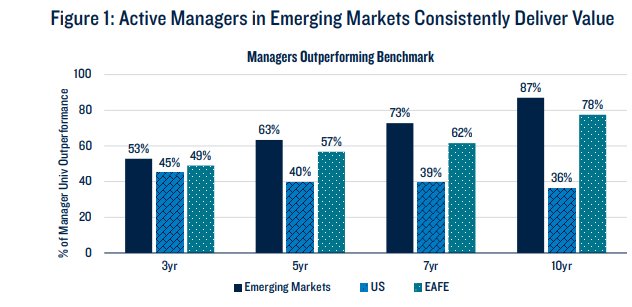
Source: PGIM
Why the Outperformance?
Why the outperformance? Why have active managers excelled in emerging markets while index funds failed? The answer lies in one word: inefficiencies.
We often paint emerging markets with a broad brush, lumping all 24 MSCI Index nations as one. In reality, these economies sit at different development stages.
Some face headwinds while others enjoy tailwinds, all at varying times. Information flows unevenly, accounting standards vary widely, regulations differ by country, and corporate governance remains inconsistent. These factors create frequent mispricing that skilled managers exploit. PGIM data confirm vast return dispersions among emerging market nations, far exceeding those in developed Europe and the United States.
Broad emerging market indexes often rely on a few countries, with China alone holding a large share. China offers huge opportunities but also unique regulatory, geopolitical, and policy risks. Passive investors have little control over this exposure, regardless of risk tolerance or outlook.
Active managers deliberately underweight or avoid countries with rising risks or inadequate valuations for uncertainty. They also boost exposure to underrepresented markets that are improving structurally but too small to have meaningful weight in an index.
Active strategies evolve with markets. As countries mature or reform, managers reallocate capital dynamically. Passive strategies adjust only after market capitalization reflects changes, often long after opportunities arise.
Active ETFs Are the Ideal Vehicle for Emerging Markets
While active management suits emerging markets, the ETF structure enhances its effectiveness. Active ETFs blend professional management with ETFs’ structural benefits as the dominant vehicle.
Active ETFs provide daily liquidity, transparency, and operational efficiency. Investors see holdings, adjust exposures intraday, and integrate strategies into portfolios seamlessly. Compared to mutual funds, active ETFs offer better tax efficiency, especially valuable in high-turnover emerging market strategies.
Costs matter too. Boots-on-the-ground research costs more in inefficient sectors like emerging markets. ETFs’ low-cost structure reduces this burden, letting active managers deliver alpha to investors after fees.
Investors should use active ETFs for emerging market exposure over passive ones. They deliver better returns, lower risks, and tax savings compared to broad passive index funds. Switching now makes sense, especially with the active ETF boom creating many new emerging market options.
Active Emerging Market ETFs
These ETFs offer emerging market exposure via active management. Sorted by YTD total return from 3.8% to 7.1%, they have expenses of 0.33% to 0.95%, AUM from $33M to $3.39B, and yields of 0% to 3.8%.
| Ticker | Name | AUM | YTD Price Ret (%) | Yield | Exp Ratio | Security Type | Actively Managed? |
|---|---|---|---|---|---|---|---|
| DFEV | DFA Dimensional Emerging Markets Value ETF | $408.7M | 7.1% | 0.4% | 0.46% | ETF | Yes |
| MEM | Matthews Emerging Markets Equity Active ETF | $57.5M | 6.8% | 0% | 0.79% | ETF | Yes |
| RFEM | First Trust RiverFront Dynamic Emerging Mkts ETF | $33.1M | 6.7% | 0% | 0.95% | ETF | Yes |
| AVEM | Avantis Emerging Markets Equity ETF | $3.397B | 6.4% | 3.8% | 0.33% | ETF | Yes |
| DFEM | DFA Dimensional Emerging Markets Core Equity 2 ETF | $2.044B | 5.5% | 0.5% | 0.40% | ETF | Yes |
| JEMA | JPMorgan ActiveBuilders Emerging Markets Equity ETF | $1.006B | 3.8% | 2.8% | 0.33% | ETF | Yes |
Emerging markets remain complex, inefficient, and evolving—conditions that favor active management. Data shows active managers are more likely to outperform passive strategies here, especially with strong risk management and country selection. Active ETFs make this accessible via professional oversight, transparency, liquidity, and lower costs.
Bottom Line
For investors looking to achieve emerging market growth while simultaneously managing downside risk and avoiding concentration inherent in index funds, active ETFs are a compelling and essential tool for modern portfolio construction.
1 PGIM (February 2025). Unlocking Alpha In Emerging Markets: Why Active Management Matters.