Over the past several years, active exchange-traded funds have become one of the most important developments in asset management. What was once a market dominated almost entirely by passive index funds has evolved into a far more diverse ecosystem where investors can access active management through the tax-efficient, transparent, and liquid ETF structure. In many categories, active ETFs have demonstrated stronger success rates than their mutual fund counterparts, leading some investors to question whether active management may be experiencing a renaissance.
However, there is an important caveat.
The rise of active ETFs does not mean that every active manager is suddenly creating value, nor that investors should ignore one of the most important variables in investing: cost. Research continues to show that one factor remains remarkably consistent across both active and passive investing.
Active ETFs Are Winning More Often
Active ETFs have grown from a niche asset to a major force in portfolio construction. Since 2020, nearly 3,000 active ETFs have launched and now hold $1.6 trillion in assets.
This surge of enthusiasm is easy to understand.
Traditional active mutual funds have long struggled to outperform their benchmarks after fees, and investors often paid expense ratios exceeding 1% annually only to receive performance that failed to justify the additional cost.
Active ETFs have improved that equation.
Many active ETFs charge significantly lower fees than their mutual fund predecessors and benefit from ETF-specific advantages, including lower portfolio turnover costs, improved tax efficiency, and greater transparency.
These advantages have helped improve the odds of success.
Morningstar’s research shows that active ETFs generally achieve higher survival and success rates than active mutual funds across numerous investment categories. Investors have taken notice, driving enormous asset growth in actively managed ETF strategies covering equities, fixed income, options-based income, alternatives, and thematic investing.
The result has been a significant shift in investor perception, with investors recognizing that some active managers can add value.
Fees Remain One of the Best Predictors of Success
Even within this success story, one factor continues to separate winners from losers: fees matter even for active ETFs.
That is the key finding of Morningstar’s latest survey on fund fees and returns, which shows that fees continue to separate winners from losers in fund management regardless of whether the strategy is active or passive.
Digging into the data, Morningstar found that over the 10 years through 2025, 31% of active funds in the cheapest quintile of their respective categories beat their average passive peer, compared with 17% for the priciest funds. 1
The math is straightforward. A portfolio generating a gross return of 8% annually would deliver 7.75% after a 0.25% fee but only 7.10% after a 0.90% fee, and over a decade or more that gap compounds into a meaningful difference in wealth creation.
This is the essence of the so-called “fee hurdle” problem. Higher-cost managers must consistently overcome a larger performance deficit before investors see any excess return, since every active manager starts each year behind their benchmark by roughly the amount of their expense ratio. A higher-cost fund effectively consumes most of the value the manager’s skill creates.
This dynamic becomes even more important because generating alpha is difficult, which helps explain why low-cost active funds consistently outperform their more expensive peers.
The marketplace increasingly reflects this reality.
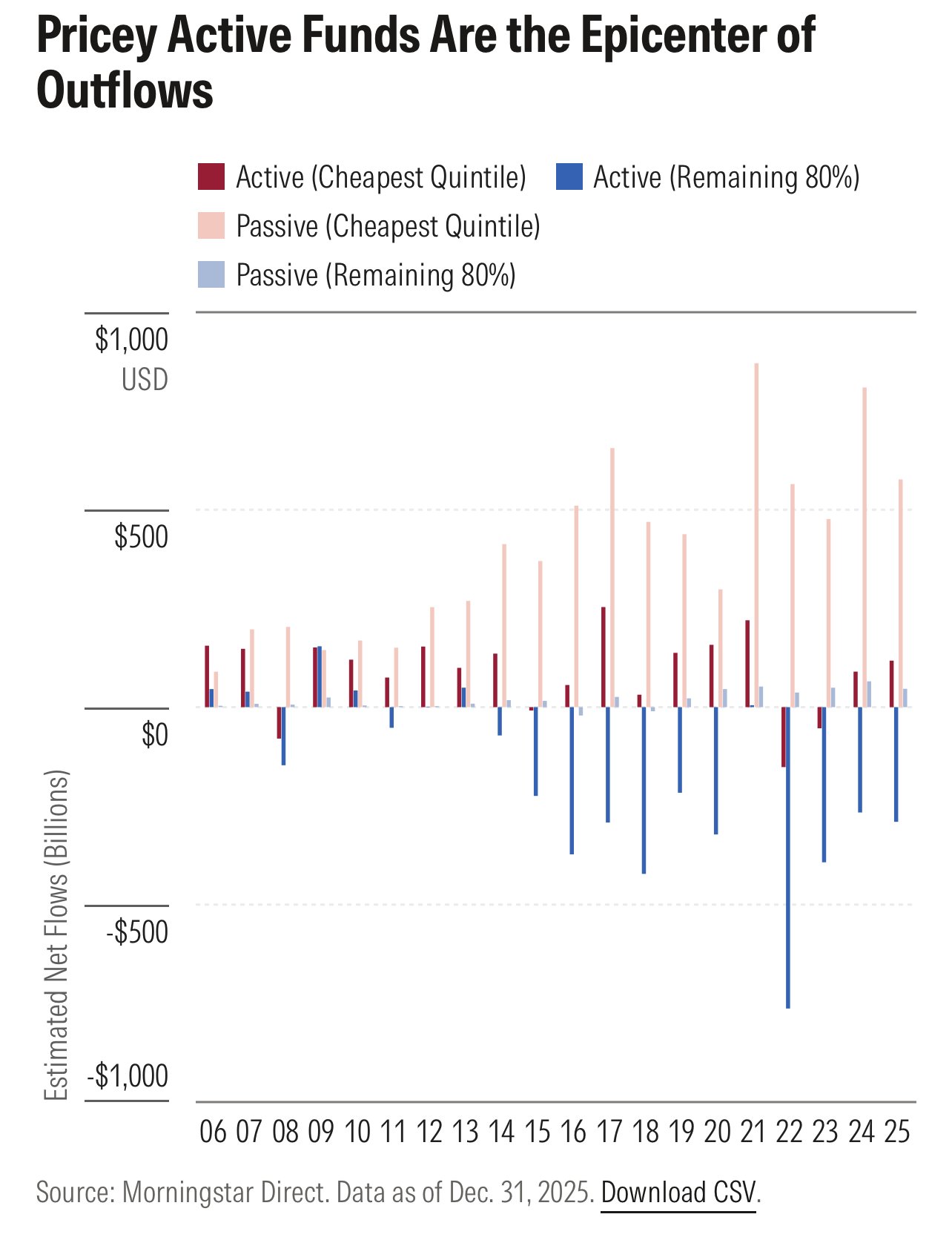
While active ETFs continue attracting strong inflows overall, investors are becoming more selective about where they allocate capital.
Low-cost active ETFs have captured the majority of industry flows, while higher-cost strategies face growing challenges gathering assets and, in some cases, are experiencing outflows. This chart from the researcher highlights how low-cost active ETFs are gathering all the flows.
Source: Morningstar
The Sweet Spot: Low-Cost Active ETFs
The growing popularity of active ETFs may ultimately represent the best of both worlds.
Investors gain access to professional security selection and active portfolio management while benefiting from generally lower costs than traditional mutual funds.
Many of today’s most successful active ETF launches have embraced this reality by following systematic strategies.
Rather than charging legacy mutual fund-level expense ratios, firms increasingly offer active ETFs at competitive prices.
This creates a more favorable alignment between managers and investors.
Managers still have an opportunity to demonstrate skill without burdening investors with excessive fee hurdles.
The result is a structure that may improve the probability of long-term success for both parties—and fees are the key to that.
Popular Active ETFs
These active ETFs, sorted by one-year total returns ranging from 4.7% to 20.6%, carry expense ratios from 0.17% to 0.36%, assets under management from $12.8 billion to $43 billion, and yields from 0.9% to 9.6%.
| Ticker | Name | AUM | 1Y Total Ret (%) | Yield (%) | Exp Ratio | Security Type | Actively Managed? |
|---|---|---|---|---|---|---|---|
| AVUV | Avantis U.S. Small-Cap Value ETF | $22.2B | 20.6% | 1.3% | 0.25% | ETF | Yes |
| DFUV | Dimensional U.S. Marketwide Value ETF | $13.5B | 20.5% | 1.3% | 0.21% | ETF | Yes |
| DFAT | Dimensional U.S. Targeted Value ETF | $12.8B | 19.1% | 1.5% | 0.28% | ETF | Yes |
| DFAC | Dimensional U.S. Core Equity 2 ETF | $41.6B | 17.3% | 0.9% | 0.17% | ETF | Yes |
| JEPQ | JPMorgan Nasdaq Equity Premium Income ETF | $32B | 13.5% | 9.6% | 0.35% | ETF | Yes |
| JEPI | JPMorgan Equity Premium Income ETF | $43.2B | 9.3% | 7.0% | 0.35% | ETF | Yes |
| FBND | Fidelity Total Bond ETF | $24B | 7.0% | 3.8% | 0.36% | ETF | Yes |
| JPST | JPMorgan Ultra Short Income ETF | $36.4B | 4.9% | 4.1% | 0.18% | ETF | Yes |
| MINT | PIMCO Enhanced Short Maturity Active ETF | $14.8B | 4.7% | 4.1% | 0.36% | ETF | Yes |
The growth of active ETFs has been one of the most significant trends in modern investing. The structure has helped active managers compete more effectively against passive funds while giving investors greater flexibility, transparency, and tax efficiency.
Yet one lesson remains unchanged: fees still matter.
Morningstar’s research consistently shows that lower-cost funds tend to have higher odds of success than their more expensive counterparts.
Bottom Line
For investors evaluating active ETFs, the question should not simply be whether a manager is active or passive—the more important question may be whether the manager’s fee leaves enough room for skill to shine through.
1 Morningstar (May 2026). How Active ETFs Are Reshaping Fund Fees